
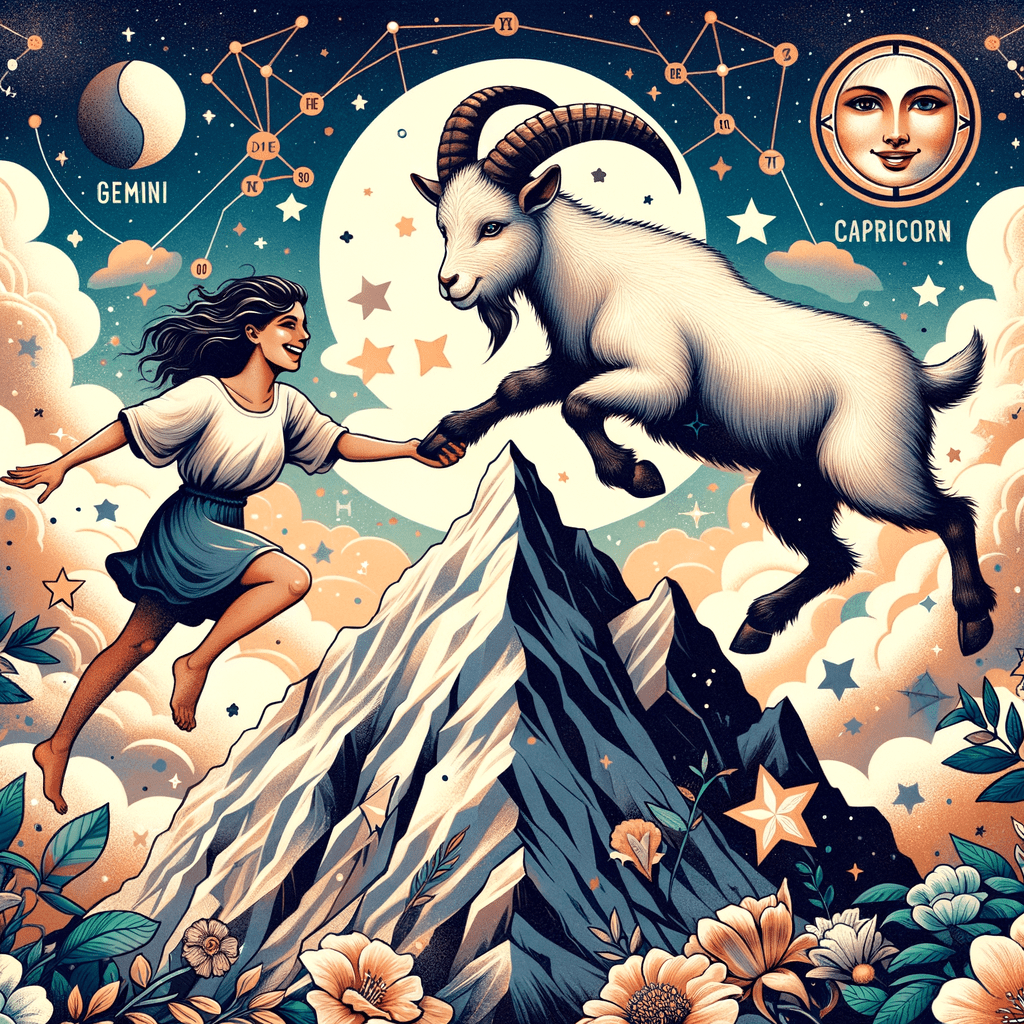
Gemini and Capricorn compatibility is one of the most searched sign pairs in the US. Most answers call the two signs a square, the angle of friction. That is wrong. Count the signs and you get five, not three. Gemini and Capricorn form a quincunx, an angle of 150 degrees. The old books treat that gap in a very different way. So this page starts from the count, then checks the rest with real numbers. We counted 62.2 million US births to see how many couples are one Gemini and one Capricorn. We measured how many of those couples form a close quincunx. And we read what Ptolemy and William Lilly said about signs placed this way.

The quick answer, in six lines
| Question | What we found. |
|---|---|
| How far apart are the signs? | Five signs, or 150 degrees on average, a quincunx and not a square. |
| How common is the pair in the US? | About 1 random couple in 77. |
| How many couples form a close quincunx? | About 19 in 100 within 3 degrees, and 36 in 100 within 6 degrees. |
| What did Ptolemy call signs five apart? | Disjunct, or alien: signs with no bond at all. |
| What links the two rulers? | Saturn, ruler of Capricorn, governs the air signs by day, and Gemini is one of them. |
| Did real marriages favor or avoid the pair? | Neither, since the gap was 0.4 percent, inside the noise. |
Start with what no one can promise
Astrology is not a science. No study has shown that a Sun sign predicts whether a couple will last. The largest test we know of was run by David Voas, then a researcher at the University of Manchester, in 2007. He took the 2001 census of England and Wales. He looked at the birth dates of 10.3 million married couples. He found no sign pair that married more than chance would allow. A small excess of couples who share a sign did show up. It came from errors in how the forms were filled in, not from the stars. The Skeptical Inquirer reported his result in March 2008.
We checked his corrected table for this pair. Voas counted 133,788 couples made of one Gemini and one Capricorn. Chance alone predicts about 134,365. That is 0.4 percent fewer. With 66 mixed pairs of signs to check, gaps of that size turn up by chance alone. So real marriages did not avoid this pair, and did not favor it.
So this page does not rate the match. It treats the pairing as a way of reading two people. Think of it as a lens, not a forecast. The lens gives two partners words for how each one works. It shows where they can talk past each other. The stars do not decide the outcome. The two people do.
Count the signs: five, not three
Start at Gemini and walk backward around the wheel. Taurus is one step, then Aries, then Pisces, then Aquarius, then Capricorn. That is five steps. Walk forward instead and you need seven. Each sign is a slice 30 degrees wide. Five slices make 150 degrees.
An aspect is a set angle between two points in the sky. The 150 degree angle is called a quincunx, from the Latin for five twelfths. Some books call it an inconjunct, which means not joined. A square is a gap of three signs, or 90 degrees. Gemini squares Virgo and Pisces. Capricorn squares Aries and Libra. Gemini and Capricorn are not on either list.
The old version of this page called the pair a square. It was wrong, and we have fixed it. The mistake is common. Gemini and Capricorn feel far apart, one light and quick, one slow and heavy. But feeling far apart is not the same as a 90 degree angle.
What a quincunx means in a chart
Ptolemy did not count 150 degrees as an aspect at all. Later astrologers added it as a minor one. Modern writers read it as two parts of a chart that share nothing. They are not at war, like a square, and not in tune, like a trine. They run on two kinds of fuel. So the work is not to win a fight. It is to set up a working deal between two systems that do not speak the same tongue.
That fits this pair well. Gemini is an air sign. Air, in astrology, stands for thought, talk and contact. Capricorn is an earth sign. Earth stands for matter, work and results. Gemini is mutable, which means it falls at the end of a season and bends to change. Capricorn is cardinal, which means it opens a season and starts things. So they differ in element and in mode at once.
How common is a Gemini and Capricorn couple?
Your Sun sign is the slice of the zodiac the Sun was in when you were born. The slices are not the same size in the birth count. We use one reference for all our pair pages. It is 62.2 million US births from 2000 to 2014, counted by day. The Social Security Administration published the counts, and the data site FiveThirtyEight made them public.
In that count, 8.56 percent of babies are Gemini. Only 7.63 percent are Capricorn. Now pair two people at random. A couple can be a Gemini woman with a Capricorn man, or the reverse. Both count. So the chance is two times 8.56 percent times 7.63 percent. That gives 1.31 percent, or about 1 couple in 77.
| What we compared | Chance for a random US couple. |
|---|---|
| Gemini and Capricorn | About 1 in 77. |
| What an even split of twelve signs would give | About 1 in 72. |
| Rank among the 66 mixed pairs | The 15th rarest of them. |
| Rank of Gemini among the twelve signs | Fourth most common. |
| Rank of Capricorn among the twelve signs | Last of the twelve. |
We checked this with a second file. The National Center for Health Statistics counted 39.7 million US births from 1994 to 2003. There, Gemini holds 8.59 percent and Capricorn 7.60 percent. The pair rate comes out the same, 1 couple in 77.
Why is Capricorn so small? The Sun moves faster in the northern winter, when Earth is closest to it. So it spends only 29.4 days in Capricorn, the shortest stay of the twelve, as our Capricorn sign page shows. US births dip in winter too. Both push the same way.
Gemini goes the other way. The Sun moves slowly near the start of summer, so it spends 31.3 days in Gemini, the second longest stay. Our page on the Gemini sign gives the full table. A big sign meets the smallest one, and the pair lands a little below an even split.
What does 1 in 77 mean in real life? Put 77 random couples in a room. About one of them will be a Gemini with a Capricorn. That is not rare. It sits a bit below the average pair of signs.
How many couples form a true quincunx?
Here is the catch that most pages skip. A sign is 30 degrees wide. So the real gap between two Suns can be anything from 120 to 180 degrees. Take a Gemini born on the first day of Gemini and a Capricorn born on the last day of Capricorn. Their Suns are about 121 degrees apart. That is close to a trine, the easy angle of four signs. Now flip it. A Gemini born on the last day and a Capricorn born on the first day are about 179 degrees apart. That is close to an opposition, the angle of six signs.
Sign pages call all of these a quincunx. A chart reader would not. Astrologers call a real aspect only when the angle is close. The room they allow is called the orb. For a quincunx, most use a small orb, from 2 to 6 degrees.
So we measured the real gap. For each day from 2000 to 2014, we placed the Sun at each hour. We gave each hour its share of the births that day. Then we paired each Gemini hour with each Capricorn hour, weighted by births.
| How close to 150 degrees | Share of Gemini and Capricorn couples. |
|---|---|
| Within 1 degree | 6.5 percent of them. |
| Within 2 degrees | 12.8 percent of them. |
| Within 3 degrees | 18.9 percent of them. |
| Within 6 degrees | 36.0 percent of them. |
| Within 8 degrees | 46.3 percent of them. |
| Within 10 degrees | 55.6 percent of them. |
With a tight 2 degree orb, only about 1 couple in 8 has a true quincunx. With a loose 6 degree orb, about 36 couples in 100 do. The other 64 have no close link between the two Suns at all. These shares match what we found for all the other sign pairs on this site. That is expected. Any two signs that are 30 degrees wide give about the same spread.
A few couples form a different aspect. About 1.4 percent sit within 5 degrees of 180, an opposition across the sign line. About 1.5 percent sit within 5 degrees of 120, a trine across the sign line. For those couples, a chart reader would read the opposition or the trine, not the quincunx.
Which birthdays make an exact quincunx?
An exact quincunx needs both Suns at the same degree of their signs. Say the Capricorn Sun sits at 15 degrees Capricorn. The Gemini Sun must then sit at 15 degrees Gemini. We timed that trip for each degree and each year from 1990 to 2030. The Sun takes about 151.3 days to move from a degree of Capricorn to the same degree of Gemini. The shortest trip took 150.4 days, and the longest 152.3 days.
So here is a simple test. Count the days from the Capricorn birthday to the Gemini birthday, ignoring the year. If you get about 151, give or take 3, the Suns form a close quincunx. For example, a Capricorn born around January 5 and a Gemini born around June 5 fit well. Birth hour moves the result by less than a degree.
What Ptolemy said: signs with no bond
Ptolemy wrote the Tetrabiblos in Alexandria around 150 AD. In Book 1, he lists the ways two signs can be tied. We read chapters 13 to 19 in the Robbins translation. Here is what they say about this pair.
First come the aspects, in chapter 13. Ptolemy counts four: the opposition, the trine, the square and the sextile. A gap of five signs is not among them. Then come two special ties, in chapters 14 and 15. Signs that command and obey sit at the same distance from an equinox sign. Signs that behold each other sit at the same distance from a solstice sign, so their days last the same length.
Chapter 16 names the rest. Ptolemy calls them disjunct, or alien. These are signs with none of the ties above. They are one or five signs apart. Signs one apart are turned away from each other. Signs five apart split the circle into unequal parts, while the true aspects split it evenly. That is the rule. It covers a gap of one sign and a gap of five signs. It does not cover a gap of six or of eight. Many sites get that wrong.
So by whole signs, is this pair disjunct? Check the two special ties. Robbins lists the commanding pairs in a note. Gemini pairs with Aquarius, and Cancer with Capricorn. Robbins lists the pairs that behold each other in another note. Gemini pairs with Leo, and Capricorn is left without a mate. So Gemini and Capricorn share no tie in the list. In Ptolemy’s scheme, read sign by sign, they are disjunct. Modern writers such as Chris Brennan call this state aversion: two signs that cannot see each other.
The second reading: by degree, the pair rises in equal time
There is another way to read chapter 14. Ptolemy measures the distance from the equinox, and the equinox is a point, not only a sign. Take the first point of Aries, where the Sun sits at the March equinox. Gemini lies 60 to 90 degrees after it. Capricorn lies 60 to 90 degrees before it. So a degree of Gemini and a degree of Capricorn can sit at the same distance from that point.
When they do, the two points rise in the same length of time. They sit the same distance from the celestial equator, one north and one south. On one birthday the day is long. On the other, the night is long by the same amount. By this reading, some Gemini and Capricorn couples do share Ptolemy’s tie. Just like the beholding signs, the tie has two readings, one by sign and one by degree. We give both, because the text supports both.
Lilly’s contra-antiscion
William Lilly gave this degree link a name in Christian Astrology, printed in London in 1647. First he defines the antiscion, a mirror point across the solstice axis. Gemini sends its antiscion into Cancer. Then he defines the contra-antiscion, the point opposite the antiscion. That point falls in Capricorn. So a planet at 10 degrees Gemini has its contra-antiscion at 20 degrees Capricorn. Lilly says the contra-antiscion works like a square or an opposition. That is the one real link to a square in this pair, and it is a mirror, not an angle.
How many couples have it? Add the two Sun degrees. If the sum is close to 30, the Suns sit in contra-antiscion. We ran the same birth count. About 6.5 percent of couples fall within 1 degree. About 12.8 percent fall within 2 degrees. Here is a rule of thumb. Count the days from the Capricorn birthday to the March equinox. Then count from the equinox to the Gemini birthday. For a close contra-antiscion, the second count is 2 to 4 days longer than the first.
Lilly has a simpler list too. He calls the six signs from Aries to Virgo commanding and the six from Libra to Pisces obeying. On that list, Gemini commands and Capricorn obeys. Take it as an old label, not a rule for who leads in a home.
Mercury and Saturn: the rulers do meet
Each sign has a ruling planet, the planet that owns it. Ptolemy gives Gemini to Mercury, the planet of speech and trade. He gives Capricorn to Saturn, the planet of time and limits. The two signs share nothing. The two rulers share a lot.
Look at chapter 18, on the triangles. Ptolemy groups the signs in four sets of three by element. The air set is Gemini, Libra and Aquarius. He assigns it to Saturn by day and to Mercury by night. So Saturn, the ruler of Capricorn, helps govern Gemini’s own element. The earth set is Taurus, Virgo and Capricorn. It goes to Venus by day and the Moon by night. Mercury gets no share there, even though Virgo is its second home. So the tie runs one way. Saturn has a seat in Gemini’s element. Mercury has none in Capricorn’s.
Chapter 19 adds a second thread. Saturn is exalted in Libra, which means it is honored there. Mercury is exalted in Virgo. Libra is an air sign, like Gemini. Virgo is an earth sign, like Capricorn. So each ruler is honored in the other partner’s element. Our page on Libra and Capricorn compatibility follows the Saturn side of that tie.
How many couples have both rulers at home?
A ruler at home is a planet placed in its own sign. It is the strongest state a planet can hold. Our sign pages measured how many natives have it. Mercury sits in Gemini for 47.85 percent of Gemini Suns, over 1600 to 2400. Saturn sits in Capricorn for 10.15 percent of Capricorn Suns, over 27 full laps of Saturn, from 1613 to 2408.
The two births are not linked, so the shares multiply. About 4.9 percent of Gemini and Capricorn couples have both rulers at home. That is about 1 couple in 20. The Gemini side is easy, a coin toss. The Capricorn side is the hard one. Saturn needs about 29 years to cross the zodiac, so it spends only a few years of each lap in Capricorn.
Mercury limits the other mixes. It never strays more than about 28 degrees from the Sun. So a Gemini has Mercury in Taurus, Gemini or Cancer. A Capricorn has Mercury in Sagittarius, Capricorn or Aquarius. The two partners’ Mercury can never share a sign.
The same limit holds in another quincunx with a Mercury ruler, where our page on Virgo and Aquarius compatibility counts the couples whose two Mercury signs form a trine instead.
Where each partner’s Venus can sit
Venus is the planet astrology ties to love and taste. Like Mercury, it stays close to the Sun, within about 47 degrees. So a Gemini has Venus in Aries, Taurus, Gemini, Cancer or Leo. A Capricorn has Venus in Scorpio, Sagittarius, Capricorn, Aquarius or Pisces. The two lists never overlap. Our page on Venus sign compatibility for Gemini and Capricorn reads each of those mixes.
This is why a Sun sign pair says so little on its own. Two people can share a Venus link, a Moon link or a Mars link that the Suns never show. A full reading lays one chart over the other. Astrologers call that method synastry.
How the pair can play out day to day
Now the reading itself. Keep the lens idea in mind. These are the themes the tradition gives each sign. Any real person will fit some and not others.
What each partner brings
Gemini brings speed, range and talk. Mercury rules words, trade and quick links between ideas. A Gemini partner notices things, names them and moves on. Gemini wants the day to have a few surprises in it.
Capricorn brings time, form and follow through. Saturn rules structure, duty and the long game. A Capricorn partner builds things that last and keeps score of what was promised. Capricorn wants the day to have a plan in it.
Where they meet
Both signs are dry, in the old sense. Air and earth are not the water signs of deep feeling. So a row between them is more likely a debate than a flood. Both value skill. Capricorn respects people who are good at things. Gemini is good at a lot of things, and fast.
The ruler link helps too. Saturn has a seat in the air signs, so a Capricorn is not a stranger to ideas. It wants ideas that hold weight. Gemini can supply the ideas. Capricorn can test which ones will stand.
Where they rub
Pace is the first gap. Gemini decides in an hour. Capricorn decides in a season. Each can read the other as wrong. Gemini sees dragging. Capricorn sees drift.
Proof is the second gap. Saturn asks for deeds. Mercury pays in words. A Capricorn partner can wait for the deed while a Gemini partner thinks the talk was the deal. Liz Greene, in Saturn: A New Look at an Old Devil, reads Saturn as a fear we grow past, not a curse. Seen that way, Capricorn’s need for proof is a guard, not a judgment.
Rest is the third gap. Gemini refuels around people and news. Capricorn refuels in quiet, or with a few old friends. Neither way is wrong. They just draw on different wells.
What helps, in the words of the tradition
The quincunx has no built in bridge, so the bridge must be made. Stephen Arroyo, in Astrology, Psychology and the Four Elements, links air with ideas and relating, and earth with practical, solid life. A couple that names this can trade on it. The Gemini partner makes fewer promises and keeps all of them. The Capricorn partner says the warm thing out loud. Small, kept words build the proof Saturn wants. Spoken warmth gives Mercury the contact it needs.
These are not rules for a couple. They are the themes the old books point to. Two real people will write their own terms.
The same angle in another pair
Gemini and Capricorn are not the only quincunx on this site. Our page on Cancer and Aquarius compatibility runs the same test on another pair five signs apart. It finds the same orb shares and the same disjunct status in Ptolemy. For the full list of signs and their dates, start with our guide to the zodiac signs.
Gemini has one more quincunx, and our page on Gemini and Scorpio compatibility checks it against Ptolemy too.
How we measured this
You can redo each number on this page.
For the Sun sign shares, we used two daily birth files published by FiveThirtyEight. One comes from the Social Security Administration and covers 2000 to 2014. The other comes from the National Center for Health Statistics and covers 1994 to 2003. We found each Sun sign change with astronomy-engine, an open source sky library, in the tropical zodiac. We spread each day’s births evenly over its 24 hours in Chicago time. When the Sun changed sign that day, we split the births by the hours before and after.
For the pair rate, we assumed that partners’ birth dates are not linked, which is what Voas found. The chance of one Gemini and one Capricorn is then two times the Gemini share times the Capricorn share.
For the quincunx and the contra-antiscion, we took the Sun’s place at each hour from 2000 to 2014, weighted by births. We built the spread of Gemini degrees and of Capricorn degrees. Then we combined them to get the spread of the gap, and of the sum. As a check, we redid it with the short solar formula of Jean Meeus, using one point per day at noon. Both routes gave the same shares to within a tenth of a point.
For the 151 days, we timed the Sun from each degree of Capricorn to the same degree of Gemini, for each year from 1990 to 2030. We did it once with astronomy-engine and once with the Meeus formula. Both gave 151.30 days on average.
For the marriage check, we used Table 7 in Voas’s paper, which removes the form errors. We added the two orders of the pair and compared the total with the count that chance predicts. For the old rules, we read Ptolemy’s Book 1, chapters 13 to 19, in the Robbins translation, with his notes. We read Lilly’s pages on antiscia, pages 90 to 92 of Christian Astrology.
Frequently asked questions
Are Gemini and Capricorn compatible?
Astrology reads the pair as two signs with no direct bond but linked rulers. The signs sit five apart, a quincunx, and Ptolemy calls such signs disjunct. Saturn, ruler of Capricorn, governs the air signs by day, and Gemini is one of them. No study has shown that any sign pair lasts longer, so treat this as a lens, not a forecast.
Are Gemini and Capricorn a square?
No. A square is three signs apart, or 90 degrees. Gemini and Capricorn are five signs apart, or 150 degrees on average. That angle is called a quincunx, or inconjunct. Gemini squares Virgo and Pisces. Capricorn squares Aries and Libra.
How common is a Gemini and Capricorn couple?
In US birth data, about 1 random pair in 77 is one Gemini and one Capricorn. Gemini is the fourth most common Sun sign in US births. Capricorn is the least common.
Is every Gemini and Capricorn couple a true quincunx?
By sign, yes. By degree, no. Within 3 degrees, only about 19 percent of couples have Suns in a real quincunx. Within 6 degrees, about 36 percent do. The rest sit anywhere from about 120 to 180 degrees apart.
Why are Mercury and Saturn linked?
Ptolemy assigns the air signs, Gemini, Libra and Aquarius, to Saturn by day and Mercury by night. So the rulers of Gemini and Capricorn share the government of Gemini’s element. He also makes Libra, an air sign, the place where Saturn is exalted.
Go deeper with your personal Astrovision report
Reading about astrological concepts is a great start, but nothing compares to hearing how they apply directly to you. Our users love our audio-first approach, calling it “friendly, personal, and easy to understand.” While this article gives you the “what,” a personal report gives you the “so what.” Discover your unique path with an Astrovision report—your personal ‘user manual’ delivered in our celebrated podcast format.