
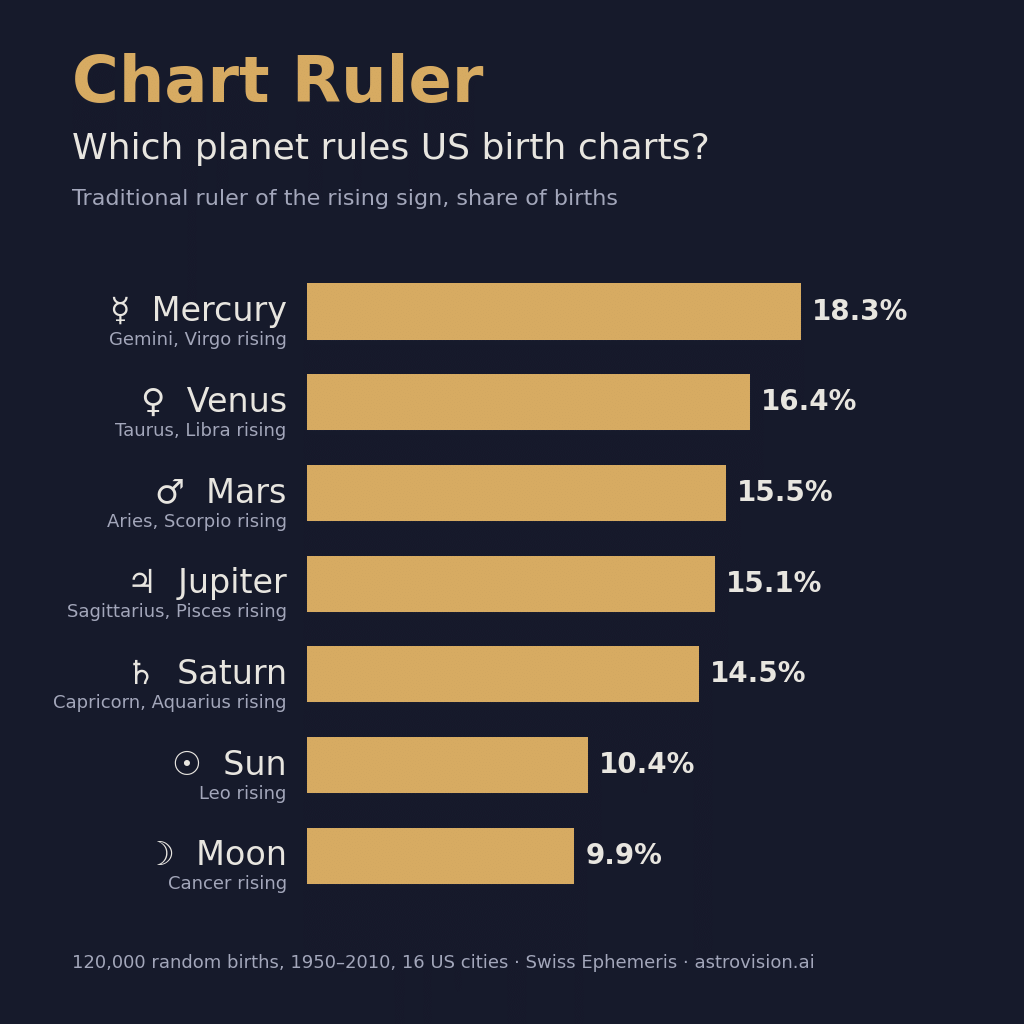
Your chart ruler is the one planet that runs your whole birth chart. It is the planet that rules your rising sign, the sign that was coming up over the eastern skyline at the minute you were born. We counted. In 120,000 US birth charts, Mercury was the chart ruler of 18.3% of them. That is close to 1 American in 5. The Moon ruled fewer than 1 in 10. This guide shows you how to find your own chart ruler in two minutes, why some planets win the count, and what each one says about you.
What is a chart ruler?
Picture your birth chart as a house with twelve rooms. Each room stands for one part of life: money, home, love, work, and so on. The planets are the furniture. The rising sign, also called the Ascendant, is the front door.
Every sign has a planet that owns it. Astrologers call that owner the sign’s ruler. Mars owns Aries. Venus owns Taurus and Libra. The planet that owns the sign on your front door is your chart ruler. In the house picture, it is the owner of the whole house. Where that owner sits, and what shape it is in, colors how you meet the world.
This idea is old. The Greek-speaking astrologers of the first centuries AD called the rising sign the Hour-Marker, because it marks the exact hour of birth. Chris Brennan traces this in his book Hellenistic Astrology (2017). In 1647, the English astrologer William Lilly wrote Christian Astrology. There he reads the “lord of the ascendant” as the planet that stands for the person: their body, their temper and the course of their life. Chart ruler is the modern name for that same lord.
What is my chart ruler? How to find it by hand
Many sites sell a chart ruler calculator. You do not need one. You need three facts and one table.
- Your birth date.
- Your birth time, to the minute if you can. It is on most US long-form birth certificates.
- Your birth place.
Put these into any free birth chart tool and read the sign on the Ascendant. Then look it up below. The modern ruler only differs for three signs. The last column shows how common each rising sign was in our sample of US births.
| Rising sign | Traditional ruler | Modern ruler | Share of US charts |
|---|---|---|---|
| Aries rising | Mars | Mars | 5.2% of charts. |
| Taurus rising | Venus | Venus | 6.2% of charts. |
| Gemini rising | Mercury | Mercury | 8.2% of charts. |
| Cancer rising | Moon | Moon | 9.9% of charts. |
| Leo rising | Sun | Sun | 10.4% of charts. |
| Virgo rising | Mercury | Mercury | 10.1% of charts. |
| Libra rising | Venus | Venus | 10.2% of charts. |
| Scorpio rising | Mars | Pluto | 10.3% of charts. |
| Sagittarius rising | Jupiter | Jupiter | 9.8% of charts. |
| Capricorn rising | Saturn | Saturn | 8.1% of charts. |
| Aquarius rising | Saturn | Uranus | 6.4% of charts. |
| Pisces rising | Jupiter | Neptune | 5.3% of charts. |
So if Virgo is rising, your chart is ruled by Mercury. If Capricorn is rising, it is ruled by Saturn. That is the whole answer to “how do I know what my chart is ruled by?”
The same three facts also give you the Part of Fortune, a point found from the Ascendant, the Sun and the Moon, with one formula for day births and another for night births.
Two warnings. First, the rising sign changes on average every two hours. A birth time that is off by thirty minutes can give you the wrong sign. Second, do not guess from your Sun sign. The Sun sign comes from your birth date. The rising sign comes from your birth time and place. They are two different things.
Your Sun, Moon and rising sign together make your Big 3, and our guide to sun, moon and rising signs shows how rare each mix of the three is.
Why Mercury rules almost 1 American in 5
Planets do not get a fair share, for two reasons.
The first reason is simple arithmetic. Mercury, Venus, Mars, Jupiter and Saturn each own two signs. The Sun and the Moon own one each. So the five “two-sign” planets start with double the chances.
The second reason is the sky itself. Some signs rise fast and some rise slowly. Think of the zodiac as a belt tied at a slant around the Earth. Seen from a US city, part of that belt comes up over the skyline at a steep angle, and it clears the horizon fast. The other part comes up at a low slant, so it takes longer. Astrologers call this oblique ascension, which just means “rising at a slant.” The slow risers are Cancer through Sagittarius. The quick risers are Capricorn through Gemini. A sign that takes longer to rise is on the front door for more minutes of the day. So more people are born with it.
The effect grows as you go north. In our sample, Seattle, at 47.6° north, gave Libra rising to 11.4% of births and Pisces rising to only 4.3%. Miami, at 25.8° north, sits much closer to the equator. There the spread was far smaller: Leo led at 9.7% and Pisces trailed at 6.4%.
Now combine the two reasons. Mercury owns Gemini and Virgo. Virgo is one of the slow, common risers. That puts Mercury on top.
| Chart ruler | Traditional rulers | With modern rulers |
|---|---|---|
| Mercury | 18.3% of charts. | 18.3% of charts. |
| Venus | 16.4% of charts. | 16.4% of charts. |
| Mars | 15.5% of charts. | 5.2% of charts. |
| Jupiter | 15.1% of charts. | 9.8% of charts. |
| Saturn | 14.5% of charts. | 8.1% of charts. |
| Sun | 10.4% of charts. | 10.4% of charts. |
| Moon | 9.9% of charts. | 9.9% of charts. |
| Pluto | Not a ruler here. | 10.3% of charts. |
| Uranus | Not a ruler here. | 6.4% of charts. |
| Neptune | Not a ruler here. | 5.3% of charts. |
How we got these numbers: we drew 120,000 birth moments at random between 1950 and 2010. Each one was placed in one of 16 large US cities, from Seattle and Boston to Miami and San Diego. We did not weight them by real birth hours, so every minute of the day counts the same. Planet and Ascendant positions come from the Swiss Ephemeris, a standard astronomy library. We used the tropical zodiac, the one most Western astrologers use. We then checked the result a second way, on a regular time grid of more than a million charts instead of random draws. Every share moved by less than a quarter of a point. Our rising sign guide ran its own count with a different sample and lands on the same order: Leo near the top, Aries and Pisces at the bottom.
Ruling planet vs chart ruler
“Ruling planet” usually means the planet that owns your Sun sign. A Gemini Sun has Mercury as its ruling planet. Every Gemini shares it, whatever their birth time. Horoscope columns use the phrase this way.
“Chart ruler” means the planet that owns your rising sign. It needs your birth time. Two Geminis born on the same day can have different chart rulers, because one was born at dawn and one at dusk.
Some astrologers do say “ruling planet” when they mean chart ruler. So check which sign the phrase hangs on. Your chart ruler is the more personal of the two.
Traditional or modern ruler?
Before 1781, astrologers knew seven planets, counting the Sun and Moon. Each sign got one of those seven. Then telescopes found Uranus, Neptune and Pluto. Later astrologers gave each new planet a sign: Uranus took Aquarius, Neptune took Pisces, and Pluto took Scorpio.
This matters for three rising signs. If you have Scorpio, Aquarius or Pisces rising, you have two candidates. Traditional astrologers read only the old ruler. Many modern astrologers read the new one, or both.
Look at what happens to Mars. With the old rulers, Mars rules 15.5% of US charts, because it owns both Aries and Scorpio. Give Scorpio to Pluto, and Mars falls to 5.2%. It becomes the rarest chart ruler of all.
Our advice is practical. Read both, and see which one fits your life. The slow outer planets stay in one sign for years. That means everyone in your school year shares the same Pluto or Neptune sign. The old ruler moves faster, so it says more about you in particular.
Where your chart ruler sits: sign and house
Next, find where your chart ruler sits: its sign and its house.
The sign shows its style. A planet in a sign it owns is said to be in its domicile, which just means “at home.” There it works in its most natural way. In our sample, the chart ruler was at home in 14.6% of charts, about 1 in 7.
The house shows the room where it lives, and so the part of life it keeps pulling you toward. We counted houses with whole sign houses. In this system, each room is exactly one sign. It is the oldest method, and Brennan’s book explains it in full. The chart ruler sat in the first house, right by the front door, in 8.1% of charts. Every other house got a similar share, about 1 chart in 12 each. So there is no “normal” house for a chart ruler. Wherever yours sits is the room your life keeps going back to.
A few examples:
- Chart ruler in the 1st house: the owner stands at the door. You come across the way you are.
- Chart ruler in the 7th house: the owner lives in the room of partners. Your life keeps turning on close ties.
- Chart ruler in the 10th house: the owner sits in the room of work and public life. Career takes center stage.
- Chart ruler in the 12th house: the owner lives in the back room. Much of your drive runs out of sight.
Your chart ruler, planet by planet
Here is what each chart ruler means, according to the tradition.
Sun as chart ruler (Leo rising)
The Sun rules 10.4% of US charts. With the Sun in charge, the chart turns around being seen and being yourself. Leo rising people want their work to carry their name.
Moon as chart ruler (Cancer rising)
The Moon rules 9.9% of charts. It is the fastest body in the sky, and a Moon-ruled chart runs on mood, care and memory. Home and the people you feed matter more than you let on.
Mercury as chart ruler (Gemini or Virgo rising)
Mercury is the most common chart ruler, at 18.3% of charts. Mercury is the planet of words, trade and quick thinking. With Mercury in charge, you meet life through questions, notes and talk. Gemini rising puts the stress on range. Virgo rising puts it on getting the detail right. Our guide to Mercury in astrology goes deeper.
Venus as chart ruler (Taurus or Libra rising)
Venus rules 16.4% of charts. Venus is the planet of pleasure, taste and ties between people. Taurus rising leans toward comfort and things that last. Libra rising leans toward fairness and pairing up. Either way, how things look and feel counts. Our guide to the planet Venus covers its full range.
Mars as chart ruler (Aries or Scorpio rising)
Mars rules 15.5% of charts under the old rules, or 5.2% if Pluto takes Scorpio. Mars is the planet of drive, heat and courage. Aries rising acts first and thinks second. Scorpio rising holds its fire and aims it. Both want a goal to push against.
Jupiter as chart ruler (Sagittarius or Pisces rising)
Jupiter rules 15.1% of charts with the old rules. It is the planet of growth, faith and big pictures. Sagittarius rising wants room to roam and a reason to believe. Pisces rising, in the old reading, pairs that faith with a soft, open heart.
Saturn as chart ruler (Capricorn or Aquarius rising)
Saturn rules 14.5% of charts with the old rules. Saturn is the planet of limits, time and hard-won skill. Capricorn rising builds step by step and earns trust slowly. Aquarius rising, in the old reading, uses Saturn’s rules to build a system for the group. In her 1976 book on Saturn, Liz Greene reads it less as a curse than as a teacher.
Pluto, Uranus and Neptune as modern rulers
If you use modern rulers, Pluto rules Scorpio rising (10.3%), Uranus rules Aquarius rising (6.4%) and Neptune rules Pisces rising (5.3%). Pluto adds depth and the urge to transform. Uranus adds a break from the norm. Neptune adds dreams and blurred edges. Since these planets move so slowly, read them next to the old ruler, not in place of it.
What if my chart ruler is retrograde?
Planets sometimes seem to move backwards from where we stand on Earth. That is what retrograde means.
It is not rare. In our grid of more than a million charts, 16% had a retrograde chart ruler, about 1 in 6. It depends on the planet. The Sun and Moon never go retrograde. Venus was retrograde in about 7% of the charts it ruled, and Mars in about 9%. Mercury was retrograde in about 19%. Jupiter was retrograde in about 30%, and Saturn in about 36%.
According to the tradition, a retrograde ruler turns its energy inward. You think twice, go back over things, and take a less direct path to the same goal. It is not a flaw. Our guide to retrograde planets in the natal chart explains how to read one.
Aspects to your chart ruler
An aspect is an angle between two planets in your chart. The main ones are the conjunction (0°, planets side by side), the square (90°) and the trine (120°). Aspects show which other planets your chart ruler works with. A trine from Jupiter lends ease. A square from Saturn adds friction and slow growth. Any planet that touches your chart ruler gets a say in the whole chart. Our guide to astrological aspects walks through each angle.
Chart ruler FAQ
How do I calculate my chart ruler?
Find your rising sign from your birth date, exact birth time and birth place. Then look up the planet that rules that sign. Mars rules Aries, Venus rules Taurus and Libra, and Mercury rules Gemini and Virgo. The Moon rules Cancer and the Sun rules Leo. Jupiter rules Sagittarius and Pisces, and Saturn rules Capricorn and Aquarius.
How do I know what my chart is ruled by?
Your chart is ruled by the planet that owns your rising sign, not your Sun sign. You need your birth time for this. In our sample of 120,000 US charts, Mercury was the most common chart ruler, at 18.3%. The Moon was the least common under the old rules, at 9.9%.
What does it mean when my chart ruler is retrograde?
According to the tradition, a retrograde chart ruler turns inward. You revisit, rethink and take side roads to your goals. It happens in about 1 chart in 6. It is most frequent with Saturn and Jupiter, and it never happens with the Sun or Moon.
What does your chart ruler signify?
It stands for you as a whole person: your body, your drive and the path of your life. That is how William Lilly read the “lord of the ascendant” in 1647. Its sign shows your style. Its house shows the part of life you keep coming back to.
Is the ruling planet the same as the chart ruler?
Not always. “Ruling planet” usually means the ruler of your Sun sign, shared by everyone born under that sign. “Chart ruler” means the ruler of your rising sign, which depends on your birth time. Check which sign the phrase refers to.
See your chart ruler in your own chart
A table can tell you which planet rules your chart. It cannot tell you what that planet is doing in your chart, with its sign, house and aspects all at once. That is what our complete natal chart reading does, with your exact birth time.
Go deeper with your personal Astrovision report
Reading about astrological concepts is a great start, but nothing compares to hearing how they apply directly to you. Our users love our audio-first approach, calling it “friendly, personal, and easy to understand.” While this article gives you the “what,” a personal report gives you the “so what.” Discover your unique path with an Astrovision report—your personal ‘user manual’ delivered in our celebrated podcast format.