
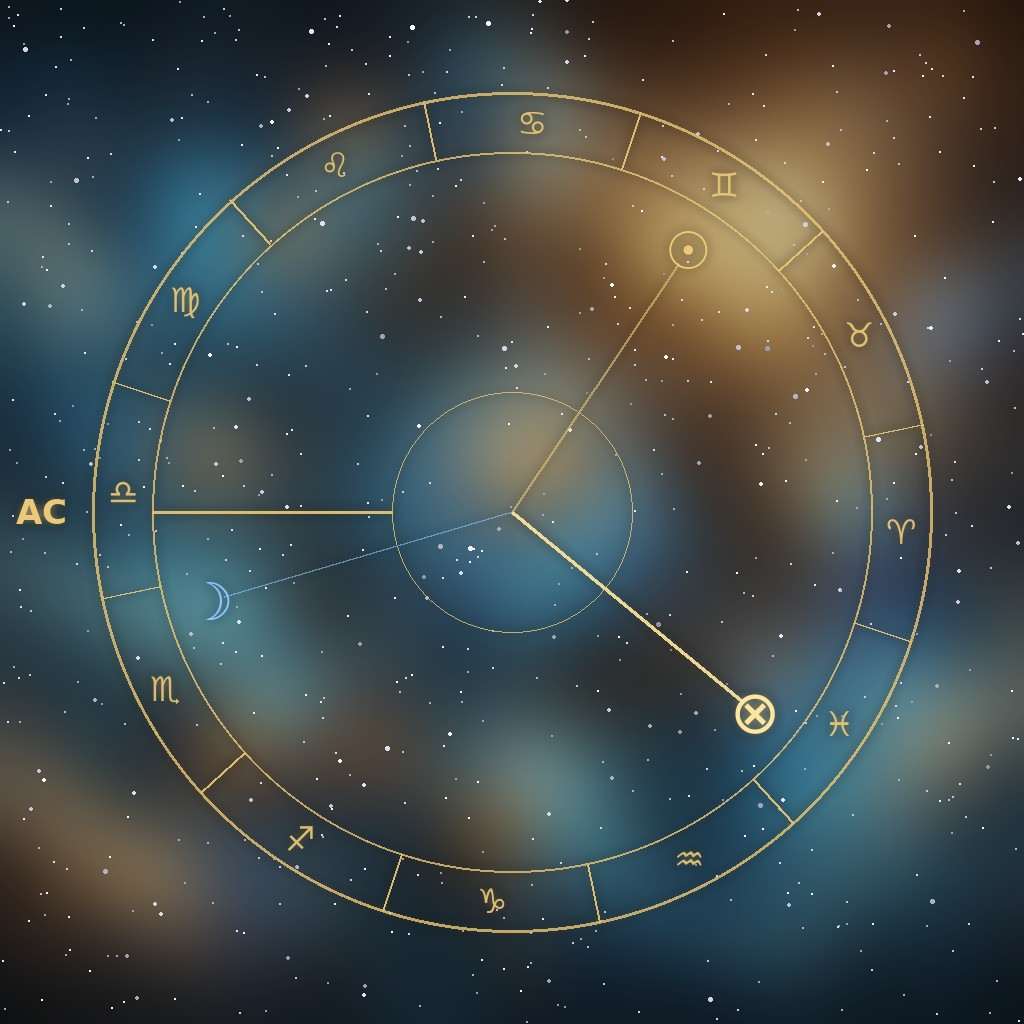
The Part of Fortune formula depends on one thing: was the Sun up when you were born? In a day chart, the formula is Ascendant + Moon − Sun. In a night chart, it is Ascendant + Sun − Moon. You can work it out by hand in four steps, and this guide walks you through a real chart, degree by degree.
The Part of Fortune formula, day and night
The Part of Fortune is not a planet. It is a point that astrologers work out from three spots in your birth chart: the Sun, the Moon and the Ascendant. The Ascendant is the sign and degree that was rising on the eastern horizon at the moment you were born. Here are the two versions of the formula.
| Type of chart | Part of Fortune formula |
|---|---|
| Day chart (Sun above the horizon) | Ascendant + Moon − Sun. |
| Night chart (Sun below the horizon) | Ascendant + Sun − Moon. |
There is a simple way to see what the formula does. In a day chart, you measure the distance from the Sun to the Moon. Then you lay that same distance out from your Ascendant. Where it ends, you find the Part of Fortune. In a night chart, you measure the other way, from the Moon to the Sun.
Some older books and some chart settings use the day formula for every chart. As you will see below, that choice moves the point to a new sign for most people born at night.
How do I know if my chart is a day chart?
Look at where the Sun sits in your chart wheel. Picture your birth chart as a house with twelve rooms. Each room covers one part of life, and the planets are the furniture. The line from the Ascendant on the left to the Descendant on the right is the horizon. Rooms 7 to 12 sit above that line. Rooms 1 to 6 sit below it.
- Sun in houses 7 to 12: the Sun was above the horizon. You have a day chart.
- Sun in houses 1 to 6: the Sun was below the horizon. You have a night chart.
Astrologers call this split sect. It is one of the oldest rules in the craft. In plain words, it just asks whether you were born in daylight or in the dark.
In our sample of 120,000 US birth times, 50.1% were day charts and 49.9% were night charts. The split was close to even in every city we checked, from Miami to Seattle.
A trap with whole sign houses
Some charts use whole sign houses. In that system, each room is exactly one sign, starting with the rising sign. This is handy, but it can blur the horizon. If the Sun sits in the same sign as the Ascendant, it can be just above the horizon or just below it. In our sample, the whole sign room count gave the wrong answer for 8.2% of charts. So for the day or night test, use the true horizon. Most chart sites show it as the line between houses 12 and 1, and between houses 6 and 7, in Placidus or any other quadrant system.
If you were born near sunrise or sunset, check with care. A few minutes can flip the Sun from one side of the horizon to the other. Then the whole formula flips too.
How to calculate the Part of Fortune by hand in 4 steps
A Part of Fortune calculator does this math in a split second. Still, it helps to know what it does, so you can spot a wrong setting. Here is the method.
- Write down the sign and degree of your Ascendant, Sun and Moon. You need your birth date, birth time and birth place to get them.
- Turn each one into a number from 0 to 360. Each sign holds 30 degrees, so add the degree to the start of its sign (see the table below).
- Check if the Sun is above or below the horizon. Then use the day or night formula.
- If the result is above 360, take 360 away. If it is below 0, add 360. Then turn the number back into a sign and degree.
| Sign | Starts at |
|---|---|
| Aries | 0 degrees. |
| Taurus | 30 degrees. |
| Gemini | 60 degrees. |
| Cancer | 90 degrees. |
| Leo | 120 degrees. |
| Virgo | 150 degrees. |
| Libra | 180 degrees. |
| Scorpio | 210 degrees. |
| Sagittarius | 240 degrees. |
| Capricorn | 270 degrees. |
| Aquarius | 300 degrees. |
| Pisces | 330 degrees. |
Worked example: a day chart
Take a real sky. Someone is born in Chicago on June 12, 1990, at 3:30 pm local time. We cast the chart with the Swiss Ephemeris, a standard tool for planet positions. Here is what it gives.
- Ascendant: 24°05′ Libra. That is 180 + 24.08 = 204.08 degrees.
- Moon: 11°07′ Aquarius. That is 300 + 11.11 = 311.11 degrees.
- Sun: 21°36′ Gemini. That is 60 + 21.60 = 81.60 degrees.
The Sun sits in the 8th house, above the horizon. It is mid-afternoon, so this is a day chart. We use Ascendant + Moon − Sun.
204.08 + 311.11 − 81.60 = 433.59. That is more than 360, so we take 360 away and get 73.59. Gemini starts at 60, so 73.59 is 13.59 degrees into Gemini. The Part of Fortune sits at 13°35′ Gemini.
With a Libra Ascendant, Gemini is the 9th sign from the rising sign. So with whole sign houses, the Part of Fortune falls in the 9th house.
Now see what the wrong formula does. With the night version, you get 4°34′ Pisces, in the 6th house. That is a new sign, a new house and a new story.
Worked example: a night chart
Same city, same day, but at 10:30 pm. The Ascendant is now 23°39′ Capricorn, or 293.66 degrees. The Sun is at 21°53′ Gemini, or 81.88 degrees. The Moon is at 14°47′ Aquarius, or 314.79 degrees.
The Sun has set, so this is a night chart. We use Ascendant + Sun − Moon: 293.66 + 81.88 − 314.79 = 60.75. That is 0°45′ Gemini, in the 6th whole sign house. The day formula would have put it at 16°34′ Virgo, in the 9th house.
Why your birth time matters
The gap between the Sun and the Moon changes slowly, about 12 degrees a day. The Ascendant, though, races around the whole zodiac in a day. So the Part of Fortune moves as fast as your Ascendant, about one degree every four minutes. If your birth time is a rough guess, the sign of your Part of Fortune is a guess too. Learn more about the rising point in our guide to the Ascendant and your rising sign.
What is the Part of Fortune in astrology?
The Part of Fortune is the best known of the lots. A lot is a point found by adding and taking away the places of planets and the Ascendant. The Greek-speaking astrologers of the Hellenistic era used dozens of them. That era runs from roughly 100 BC to 600 AD, and Western astrology begins there. Later astrologers who wrote in Arabic kept and spread these points. That is why some books call them Arabic parts. Lot of Fortune and Part of Fortune are two names for the same point.
The lot is tied to the Moon. In the old texts, it speaks of the body, of health in a broad sense, and of money and the turns of luck. Its twin is the Lot of Spirit. It uses the same three points, with the Sun and Moon swapped. Fortune points to what happens to you. Spirit points to what you choose and do.
In modern books, the Part of Fortune marks an area of life where things flow, and where effort brings a return. It is not a promise of luck or wealth. It is a place to look, not a guarantee.
Day-only vs day and night formula: what changes
Not every astrologer flips the formula at night. The split goes back a long way.
Ptolemy, the Greek writer of the second century whose Tetrabiblos shaped Western astrology, used the Lot of Fortune in Books III and IV. He drew on it for the length of life and for wealth. He counted it the same way by day and by night, with no switch. Vettius Valens, who wrote his Anthology in the same century, did switch the formula for night births. So did most of the Hellenistic tradition. In Hellenistic Astrology (2017), Chris Brennan traces this history and explains the day and night switch. Many modern astrologers who follow the old methods now use it.
Does the choice matter? We tested it on 120,000 US birth times. For a day chart, both methods give the same point. For a night chart, they never do. Here is what we found for night charts.
- The two formulas put the Part of Fortune in a different sign in 91.8% of night charts.
- Across all charts, day and night, that is 45.8%, close to one person in two.
- On average, the two answers sat 91 degrees apart, a full quarter of the zodiac.
So if a free calculator gives you one sign and a book gives you another, check which formula each one used. For a night birth, the two answers are almost never the same.
The Part of Fortune follows the phase of the Moon
Here is the part most guides skip. Look at the day formula again. Ascendant + Moon − Sun is the same as the Ascendant plus the gap from the Sun to the Moon. That gap is the phase of the Moon. At a new Moon, the Moon sits right next to the Sun, so the gap is zero. At a full Moon, it sits right across from the Sun, so the gap is 180 degrees.
So the house of your Part of Fortune tracks the Moon phase at your birth. In our sample, the link was strong.
| House of the Part of Fortune | Day chart | Night chart |
|---|---|---|
| 1st house | 93% born near a new Moon. | 94% born near a new Moon. |
| 4th house | 93% born near a first quarter Moon. | 93% born near a last quarter Moon. |
| 7th house | 94% born near a full Moon. | 94% born near a full Moon. |
| 10th house | 94% born near a last quarter Moon. | 94% born near a first quarter Moon. |
Near a phase means within 22.5 degrees of it. Notice the twist in the middle rows. In a night chart, the formula runs the other way. So the quarter Moons swap places between the 4th and 10th houses.
This also explains a myth. People ask which house is best or rarest for the Part of Fortune. In our sample, each house held between 8.1% and 8.5% of charts. No house is rare. The Moon goes through all its phases every month, so every house gets its turn.
To learn more about the Moon itself, read our guide to the Moon in your birth chart.
The Part of Fortune by house
In the Hellenistic method, you read the Part of Fortune by whole sign house. Our guide to whole sign houses explains that system in full. Here is a short reading of each room. For the full meaning of each house, see the 12 astrological houses.
- 1st house: luck comes through your own body, name and style. You make your own breaks.
- 2nd house: money, skills and what you own. Steady gains come from what you build.
- 3rd house: talk, writing, siblings and short trips. Doors open through words and your local world.
- 4th house: home, family and roots. Land, a house or a family line can bring support.
- 5th house: joy, children and play. Fun and risk can pay back, if you keep your head.
- 6th house: daily work and habits. Fortune grows in the small, steady tasks of each day.
- 7th house: partners and open deals. Gains come through others, in love and in trade.
- 8th house: shared money, debts and loss. Fortune can come through what others leave or lend.
- 9th house: travel, study and belief. Long trips and big ideas widen your luck.
- 10th house: career and public name. Fortune shows up at work and in the eyes of the world.
- 11th house: friends, groups and hopes. The old books call this the house of the good spirit, and allies bring help.
- 12th house: hidden things and solitude. Fortune comes slowly, through quiet work behind the scenes.
These lines are a start, not a verdict. The tradition reads the house, then the sign, then the planet that rules that sign.
How to read your Part of Fortune in context
Once you know the house, look at three more things.
- The sign. A fire sign brings speed and drive. Earth brings patience and craft. Air brings ideas and contacts. Water brings feeling and care.
- The ruler. Every sign has a planet that owns it. Astrologers call it the ruler. Look at where that planet sits and how strong it is. In the old method, a strong ruler backs up the Part of Fortune. Our guide to the chart ruler shows how rulers work.
- Close contacts. An aspect is an angle between two points in the chart. A planet in the same sign as the Part of Fortune, or right across from it, colors how fortune shows up. Venus there points to ease through people and pleasure. Saturn there points to slow gains and hard-won rewards.
Hellenistic astrologers went one step further. They counted the houses again from the Part of Fortune, as if it were a second Ascendant. Valens used this to judge career and wealth. The 10th sign from the Part of Fortune, for example, was read for one’s work and name.
The Part of Fortune stays fixed in your birth chart for life. Transits, the moving planets of today, touch it at different times. Astrologers watch those contacts for windows when luck or support seems to open up.
How we measured
We drew 120,000 moments at random between 1950 and 2010. Each one was paired with one of 16 large US cities, from New York to Seattle. The draws were even across time and were not weighted by real birth rates. For each moment, we found the Sun, the Moon and the Ascendant with the Swiss Ephemeris, in the tropical zodiac.
A day chart means the Sun was on the upper side of the horizon line in the chart. We checked this a second way, with the true height of the Sun in the sky. The two tests agreed in every case. For the Part of Fortune, we used the day and night formula, and counted houses by whole signs. Then we ran the whole count again on a fixed grid of times instead of random ones. The results matched within a few tenths of a point: 50.2% day charts, and 45.8% of charts with a sign change between formulas.
Keep in mind what these numbers are. They describe the sky. They do not prove that the Part of Fortune shapes a life. Astrology is a symbolic language, not a science.
Frequently asked questions
Is the Part of Fortune a planet?
No. It is a point worked out from the Sun, the Moon and the Ascendant. In a day chart it is Ascendant + Moon − Sun. In a night chart it is Ascendant + Sun − Moon.
Is the Lot of Fortune the same as the Part of Fortune?
Yes. Lot of Fortune is the older name, used by the Hellenistic astrologers. Part of Fortune is the later name, from the Latin texts. Both name the same point.
Do I need my exact birth time?
Yes. The Part of Fortune moves about one degree every four minutes, as fast as the Ascendant. The birth time also tells you if the Sun was up, which decides the formula.
Why do two calculators give me different signs?
One of them likely uses the day formula for every chart. For a night birth, the two formulas gave a different sign in 91.8% of the charts we tested. Check the settings for a day and night option.
Can the Part of Fortune change over time?
No. Your natal Part of Fortune stays fixed for life. Transits from the moving planets touch it at different times, and astrologers read those contacts as windows of support.
Want to see your own Part of Fortune with the right formula and its full reading? A complete natal chart report works it out from your exact birth time and place.
Go deeper with your personal Astrovision report
Reading about astrological concepts is a great start, but nothing compares to hearing how they apply directly to you. Our users love our audio-first approach, calling it “friendly, personal, and easy to understand.” While this article gives you the “what,” a personal report gives you the “so what.” Discover your unique path with an Astrovision report—your personal ‘user manual’ delivered in our celebrated podcast format.