
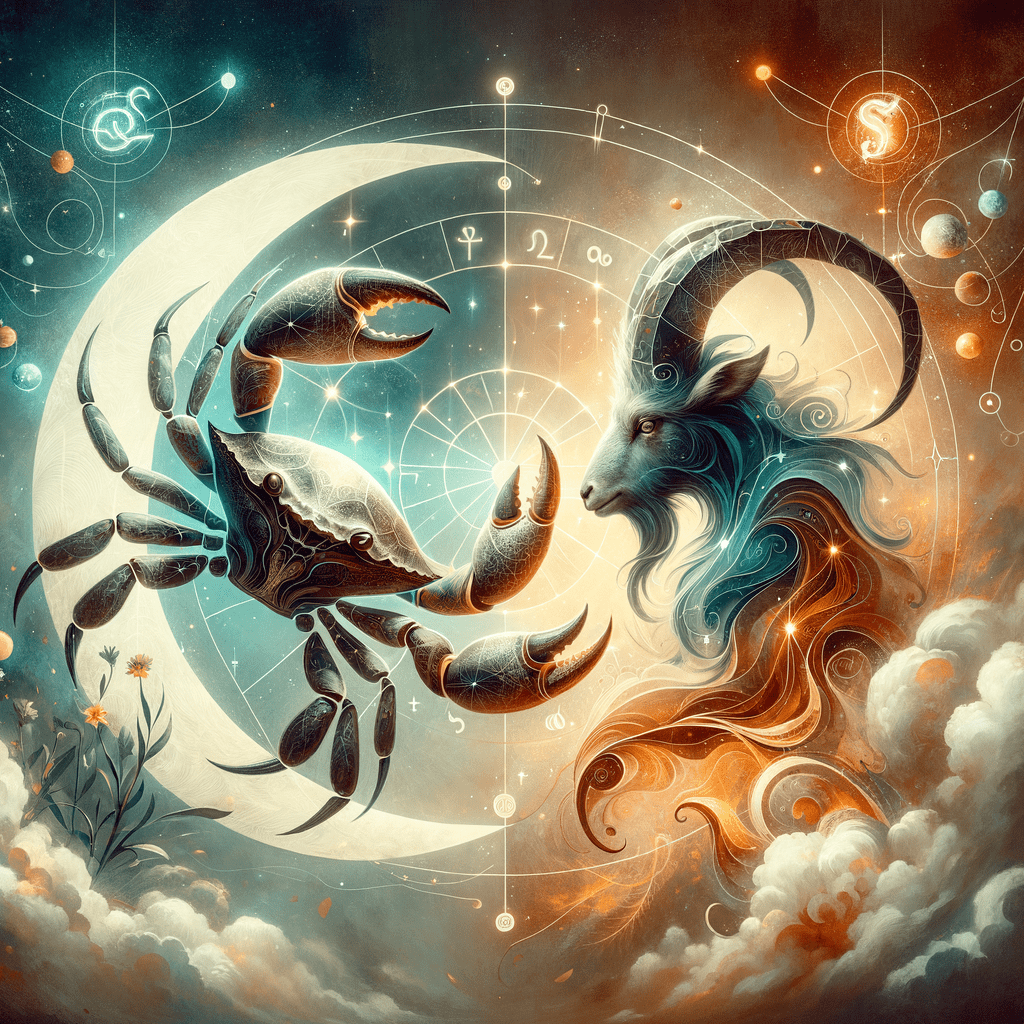
Cancer and Capricorn compatibility is a match of two ends. Cancer season starts on the longest day of the year. Capricorn season starts on the shortest. In New York, a Cancer is born with about five and a half hours more daylight than a Capricorn. No other pair of signs sits on those two turning points.
That is the thread of this page. I counted how common the pair is in US births. About 1 random US pair in 74 is a Cancer with a Capricorn. That makes it the rarest of the six pairs of opposite signs. I also went back to the oldest textbook of the craft, to see what it says about these two signs. Each number comes with its method, so you can check it.
What the census says before the stars do
Astrology is not a science. No study has shown that a Sun sign predicts whether a couple will last. The largest test I know of was run by David Voas, then a researcher at the University of Manchester, in 2007. He used the 2001 census of England and Wales. It holds the birth dates of more than 10 million married couples. He asked if some sign pairs marry more than chance allows, and if others marry less.
His answer was no. He also found why some raw counts looked odd. Too many couples shared a sign, because a clerk or a spouse had written the same birthday twice. Once he took out those errors, the table looked as random as real data gets. The Skeptical Inquirer reported his result in March 2008.
Here are the Cancer and Capricorn cells from his corrected table, Table 7. It holds 9.5 million couples.
| Couple in the 2001 census | Found | Expected by chance | Gap. |
|---|---|---|---|
| Cancer wife, Capricorn husband. | 65,271 couples. | 65,644 couples. | 373 fewer. |
| Capricorn wife, Cancer husband. | 65,133 couples. | 65,481 couples. | 348 fewer. |
| Both kinds together. | 130,404 couples. | 131,125 couples. | Half a percent fewer. |
The expected count is what you get if people pick partners with no regard to sign. Voas notes that with so many couples, a cell can drift up to 450 above or below that count by pure chance. Both cells here sit inside that range. So Cancers and Capricorns do not seek each other out. They do not avoid each other either.
So this page reads the pair as a lens, not a forecast. The lens gives two people words for how each one works. The two people decide the rest.
The two turning points of the year
A Sun sign is the slice of the sky the Sun stood in when you were born. There are twelve slices of 30 degrees each. The count starts at the spring equinox, the day in March when day and night are equal.
Two of the slices begin at a solstice. A solstice is the day the Sun stops climbing north or south in our sky and turns back. Cancer begins at the June solstice. Capricorn begins at the December solstice. The word tropic comes from the Greek for turn. That is why the two lines on a world map, where the Sun can stand straight overhead, are called the Tropic of Cancer and the Tropic of Capricorn.
Claudius Ptolemy wrote the Tetrabiblos in Alexandria around 150 AD. It is the oldest full textbook of Western astrology. I read Book 1 in the English version by Frank Robbins, from 1940. In chapter 11 he names two solstitial signs, Cancer and Capricorn. He says the Sun “turns” at the start of each one, “causing summer in Cancer and winter in Capricorn.” Modern books fold these two signs, with Aries and Libra, into one group called cardinal. Cardinal means a sign that starts a season.
So the pair is not just two signs across from each other. It is the only pair made of the two turns of the Sun. One partner was born as the days began to shrink. The other was born as the days began to grow.
Born in the longest days, born in the shortest
How big is that gap in real life? I timed sunrise and sunset in New York for every day of Cancer season in 2026 and every day of Capricorn season in the winter of 2025 into 2026. Day length here means the time from sunrise to sunset.
| New York, local dates | Cancer season, June 21 to July 22, 2026 | Capricorn season, December 21, 2025 to January 19, 2026. |
|---|---|---|
| First day of the season. | 15 hours 6 minutes of daylight. | 9 hours 15 minutes of daylight. |
| Last day of the season. | 14 hours 37 minutes of daylight. | 9 hours 42 minutes of daylight. |
| Average day of the season. | 14 hours 56 minutes of daylight. | 9 hours 25 minutes of daylight. |
On average, a New York Cancer arrives on a day with 5 hours 31 minutes more light than a New York Capricorn. Cancer season holds the longest days of the year. Capricorn season holds the shortest. The light is already fading through Cancer season. It is already coming back through Capricorn season.
The gap depends on where you are born. Here is the solstice day in three other US cities.
- Miami: 13 hours 45 minutes in June, 10 hours 32 minutes in December. The gap is a bit over 3 hours.
- Seattle: 15 hours 59 minutes in June, 8 hours 26 minutes in December. The gap is about 7 and a half hours.
- Anchorage: 19 hours 22 minutes in June, 5 hours 27 minutes in December. The gap is close to 14 hours.
There is a neat mirror in the numbers. Take a Cancer born at some degree of Cancer, and a Capricorn born at the same degree of Capricorn. In New York, their two day lengths add up to about 24 hours 20 minutes, at every degree. The extra 20 minutes is not a mistake. Sunrise counts from the moment the top edge of the Sun shows, and the air bends its light up over the rim. Each partner has, in a real sense, the other one’s night.
This is the one fact on this page that a person can feel. It says nothing about love. It does say that the two signs were named for the two ends of the year, and that the names still match the sky.
How common is a Cancer and Capricorn couple?
Sun signs are not equally common. The slices do not last the same number of days. Earth moves slowest in early July, when it is farthest from the Sun. So the Sun crawls through Cancer in about 31.45 days, the longest stay of the twelve. Earth moves fastest in early January, so the Sun races through Capricorn in about 29.45 days, the shortest stay. Our pages on the Cancer sign and the Capricorn sign measure both ends of that gap.
US births are not flat through the year either. They peak in late summer and dip in winter. So Cancer gets a long season with busy days, and Capricorn gets a short one with quiet days. I counted it with two public files of daily US births.
| Question | Social Security file, 2000 to 2014 | Health Statistics file, 1994 to 2003. |
|---|---|---|
| Births in the file. | 62.2 million births. | 39.7 million births. |
| Share born with the Sun in Cancer. | 8.84 percent, third of twelve. | 8.87 percent, third of twelve. |
| Share born with the Sun in Capricorn. | 7.63 percent, last of twelve. | 7.60 percent, last of twelve. |
| Chance a random pair is one Cancer and one Capricorn. | 1.35 percent, or 1 pair in 74. | 1.35 percent, or 1 pair in 74. |
Why multiply by two? A pair can be a Cancer woman with a Capricorn man, or the other way round. Both count. So the chance is two times the Cancer share times the Capricorn share. If every sign held one twelfth of births, any mixed pair would show up once in 72 draws. This one shows up once in 74.
Now line up the six pairs of opposite signs. Each is a sign and the sign straight across the wheel.
| Opposite pair | Chance in US births, 2000 to 2014. |
|---|---|
| Virgo and Pisces. | 1 pair in 70. |
| Leo and Aquarius. | 1 pair in 70. |
| Aries and Libra. | 1 pair in 72. |
| Gemini and Sagittarius. | 1 pair in 73. |
| Taurus and Scorpio. | 1 pair in 74, just ahead. |
| Cancer and Capricorn. | 1 pair in 74, the rarest. |
The last two are close. Taurus and Scorpio come out at 1.357 percent, Cancer and Capricorn at 1.350. Both birth files put Cancer and Capricorn last. Among all 78 possible Sun sign pairs, same sign pairs included, it ranks 45th.
Why last? Capricorn is the rarest sign, and every pair that holds it starts with a handicap. Cancer is common, but not common enough to make up for it. None of this is about love. It is about the shape of Earth’s orbit and the months when US couples conceive.
One pair on that list also holds a fact about our galaxy. Our page on Gemini and Sagittarius compatibility shows that the Sun meets the center of the Milky Way in one sign and its far rim in the other.
Six signs apart: the opposition
Place the twelve signs on a wheel. Count from Cancer: Leo, Virgo, Libra, Scorpio, Sagittarius, Capricorn. That is six steps, or 180 degrees. Astrologers call this link an opposition. An aspect is a set angle between two points in the sky, and the opposition is the widest one.
Half a year, both ways
For an exact opposition, both Suns must sit at the same degree of their signs. I timed the Sun from each degree of Cancer to the same degree of Capricorn, and back again, for every year from 1990 to 2030.
- From Cancer to Capricorn, the Sun takes between 181.5 and 183.5 days.
- From Capricorn back to Cancer, it takes between 181.7 and 183.7 days.
The two halves are almost equal. That is not true of every opposite pair. From Aries to Libra, the Sun takes about 186.4 days. From Libra back to Aries, it takes about 178.8 days. The reason is the same as for the season lengths. Earth’s closest point to the Sun falls in Capricorn season, and its farthest point falls in Cancer season. The line between those two points runs almost along the Cancer and Capricorn line, so it cuts the year into two equal halves.
Here is a real example. In 2026, the Sun reached 15 degrees of Capricorn on January 5 at 3:23 a.m., New York time. It reached 15 degrees of Cancer on July 6 at 9:57 p.m. A Capricorn born on January 5 and a Cancer born on July 6 of that year have their Suns in exact opposition.
How many pairs have a true opposition
A sign is a slice, so the label does not fix the angle. An early Cancer and a late Capricorn have Suns about 210 degrees apart, counted one way. A late Cancer and an early Capricorn are about 150 apart. The label says 180, but the real gap runs from about 150 to 210 degrees.
Astrologers only count an aspect when the angle is close to exact. The leeway they allow is called the orb. Our pages on other pairs weighed each degree by real US births and found the same shares for every pair of signs: about 19 percent within 3 degrees, 36 percent within 6, 46 percent within 8, and 56 percent within 10. The width of a sign sets those shares, not the pair. The opposition is a major aspect, so many astrologers allow it 8 or 10 degrees. On that rule, about half of Cancer and Capricorn couples have a true Sun opposition. The other half share the label, not the angle.
Where Ptolemy’s reason slips
In chapter 13, Ptolemy sorts the aspects. He calls the trine and the sextile harmonious, because they join signs of the same kind. He calls the square and the opposition disharmonious, because they join signs “of opposite kinds.” The kinds are male and female, which in his scheme alternate around the wheel.
That reason fits the square. It does not fit the opposition. Signs six steps apart always share the same kind. Cancer and Capricorn are both female signs, and in chapter 12 both are also night signs. So by his own count, this pair shares its kind, even though he files the opposition with the hard aspects. I found no note on this in the Robbins edition. It is worth knowing when a page tells you the opposition is hard “because” of gender.
What the old rules say about this pair
Ptolemy lists a few more ways that two signs can be linked. Two of them touch this pair in a way that no other pair shares.
One commands, one obeys
In chapter 14, Ptolemy pairs signs that lie the same distance from an equinox. He says they rise in the same time. The sign on the summer side is called commanding. The sign on the winter side is called obeying. The reason he gives is day length: in the summer signs, the day is longer than the night.
Robbins lists the pairs in his note 80, following older writers. Counted in whole signs, Cancer and Capricorn are one of them, with Cancer in command. Robbins adds that the first idea was that such signs heard each other, and that obeying was a later gloss. There is a second way to read the rule, degree by degree. On that reading, Cancer’s partner is Sagittarius and Capricorn’s is Gemini. Both readings are in use. I give both so you can see which one a source is using.
The two signs with no mate
In chapter 15, Ptolemy pairs signs that lie the same distance from a solstice. When the Sun is in either one, the days are the same length. He says such signs behold each other. To behold means to see, or to be linked by light.
Here the pair stands out. Counted in whole signs, Robbins lists five beholding pairs in his note 83. Then he adds that Cancer and Capricorn “are left without mates.” They are the solstices, so there is nothing on the far side to mirror them. Read degree by degree, as William Lilly did in his Christian Astrology of 1647, each degree has a mirror point, called its antiscion. On that reading, Cancer mirrors Gemini, and Capricorn mirrors Sagittarius. Either way, Cancer and Capricorn do not behold each other. What they share is the same odd place, at the two ends of the mirror.
Our page on how Gemini and Cancer mirror each other’s daylight tests that reading on real birth dates.
Rulers that trade places
Each sign has a ruler, a planet said to be at home there. The Moon rules Cancer. Saturn rules Capricorn. In chapter 17, Ptolemy says Saturn was given the signs opposite the homes of the Sun and the Moon because it is cold and far away. He adds that their “diametral aspect,” the look across the circle, “is not consistent with beneficence.” In plain words, the opposition was not seen as a kind link.
The same logic gives each planet a sign where it is weak. A planet is in detriment, or exile, in the sign across from its home. It is in fall in the sign across from its exaltation, its sign of honor. With this pair, the pattern lines up four times over.
| Planet | In Cancer | In Capricorn. |
|---|---|---|
| The Moon. | At home. | In exile. |
| Saturn. | In exile. | At home. |
| Jupiter. | Exalted. | In fall. |
| Mars. | In fall. | Exalted. |
Ptolemy explains the last two rows in chapter 19. Jupiter was given Cancer because it reaches farthest north there. Mars was given Capricorn because it is farthest south there, and so most fiery. Lilly’s table of dignities keeps the same scheme. So every planet that is strong in one of these signs is weak in the other. Each partner’s sign is the other’s hard place.
How many real charts have the rulers at home? Our sign pages measured it over long windows. The Moon is in Cancer for about 8.2 percent of Cancers. Saturn is in Capricorn for about 10.15 percent of Capricorns. So in most real couples of this pair, neither ruler is home. The trade of places is a feature of the signs, not of the people.
No shared Venus, no shared Mercury
Venus orbits closer to the Sun than Earth does. From here, it never strays more than about 47 degrees from the Sun. Mercury never strays more than about 28 degrees. Those limits box in each partner’s inner planets.
- A Cancer can have Venus only in Taurus, Gemini, Cancer, Leo or Virgo.
- A Capricorn can have Venus only in Scorpio, Sagittarius, Capricorn, Aquarius or Pisces.
- A Cancer can have Mercury only in Gemini, Cancer or Leo.
- A Capricorn can have Mercury only in Sagittarius, Capricorn or Aquarius.
The lists never overlap. Signs six apart are too far for either planet to bridge. So a Cancer and a Capricorn can never share a Venus sign or a Mercury sign. But Venus can land in two signs that face each other. A Cancer with Venus in Virgo and a Capricorn with Venus in Pisces have their Venus signs across the wheel too. The Venus pair is its own question, and our page on Cancer and Capricorn Venus placements takes it up.
How the pair can play out day to day
Here the page turns from counts to tradition. What follows is how astrologers read the two signs. Treat it as a set of images to test against your own life, not as facts about any person.
What each partner brings
Cancer is a cardinal water sign. Water stands for feeling, memory and care. A Cancer partner shows love by looking after people. A meal kept warm. A text to ask if you got home. A room that feels safe to come back to.
Capricorn is a cardinal earth sign. Earth stands for the concrete, the body and daily work. A Capricorn partner shows love through effort. A plan with dates. A bill paid before it is due. A promise that still holds in ten years.
Where they meet
Both signs start things. Both care about what lasts. Modern books read this axis as home at one end and the outer world at the other. Cancer builds the nest. Capricorn builds the wall around it. The old picture of the two solstices fits: one partner keeps the summer, the other gets through the winter.
Where they rub
The friction is about signals, not values. Each partner offers care in a form the other can miss.
| Where it snags | What Cancer feels | What Capricorn feels | A small step that helps. |
|---|---|---|---|
| Showing care. | Unseen when love comes as a task done. | Unthanked when effort is not read as love. | Name out loud what the other just did for you. |
| Moods. | Alone when a bad day gets a plan instead of a hug. | Stuck when a mood has no clear fix. | Ask first: do you want help, or just company? |
| Work and home. | Second place when work runs late. | Held back when home asks for time it cannot spare. | Put home time on the calendar with the same weight as work. |
| Family. | Hurt when family ties feel like a duty. | Drained when family plans have no end point. | Agree on the big dates each year, and keep them. |
None of these steps needs a chart. Any two people with different styles can use them. The signs only give a name to the pattern. The fix lives in plain talk.
Look past the Sun
A Sun sign is one point in a chart with ten planets and twelve houses. To read two people well, astrologers compare whole charts. That method is called synastry. It looks at how each planet in one chart meets each planet in the other.
Three placements matter most for love in the old view. The Moon shows needs and moods. Venus shows what someone finds lovely. Mars shows desire and how someone pushes for what they want. A Cancer with a Capricorn Moon, or a Capricorn with a Cancer Moon, would read very differently from the Sun pair alone.
Cancer’s other close links work in other ways. Scorpio shares its element, and our guide to Cancer and Scorpio compatibility follows Mars, the planet that falls in Cancer. Libra squares both signs of this pair, and our page on Libra and Capricorn compatibility covers that square.
If a birthday falls near a sign change, check it first. The guide to the 12 zodiac signs gives the real Sun dates for each sign. The start of Cancer moves between June 20 and June 22. The end of Capricorn moves between January 19 and January 21.
How I measured this
You can redo each number on this page.
For day length, I used astronomy-engine, an open source sky library. I found sunrise and sunset for each local date in New York, at 40.71 degrees north. I counted from the first to the last calendar day of each season. As a check, I used the textbook formula that gives day length from the Sun’s position and the latitude. It gave 14.93 and 9.41 hours as the season averages, within a minute of the timed values. Miami, Seattle and Anchorage use the same method on the solstice days.
For the Sun sign shares, I used two daily birth files published by FiveThirtyEight. One comes from the Social Security Administration and covers 2000 to 2014. The other comes from the National Center for Health Statistics and covers 1994 to 2003. I found each moment the Sun changed sign with astronomy-engine, in the tropical zodiac. I spread each day’s births evenly over its 24 hours in Chicago time. When the Sun changed sign that day, I split the births by the hours before and after.
For the pair rate, I assumed that partners’ birth dates are not linked, which is what Voas found. The chance of one Cancer and one Capricorn is then two times the Cancer share times the Capricorn share. For the ranking, I did the same for all 78 pairs.
For the census cells, I used Table 7 of the Voas paper. It leaves out couples with a birthday on the first of a month, since too many of those dates came from blanks the census office filled in. It also removes the excess of same sign couples. The expected count for each cell is the row total times the column total, divided by the grand total.
For the days between birthdays, I timed the Sun from each degree of Cancer to the same degree of Capricorn, and back, for every year from 1990 to 2030. I did it once with astronomy-engine and once with the short solar formula of Jean Meeus. Both gave the same days to within a hundredth. The season lengths come from our sign pages, which measured them over 800 years.
For the old rules, I read Ptolemy’s Book 1, chapters 11 to 19, in the Robbins version, with his notes 80 and 83. I checked the dignities against Lilly.
Frequently asked questions
Are Cancer and Capricorn compatible?
Astrology reads them as opposite signs, six signs apart, with rulers that trade places. The Moon is at home in Cancer and weak in Capricorn, and Saturn is the reverse. No study has shown that any sign pair lasts longer, so treat it as a lens, not a forecast.
How common is a Cancer and Capricorn couple?
In US birth data, about 1 random pair in 74 is one Cancer and one Capricorn. That is the rarest of the six pairs of opposite signs, because Capricorn is the rarest Sun sign in US births.
Why are Cancer and Capricorn called the solstice signs?
Cancer begins at the June solstice and Capricorn at the December solstice. Ptolemy called them the two solstitial signs, because the Sun turns back at the start of each. In New York, a Cancer is born with about five and a half hours more daylight than a Capricorn.
Do Cancer and Capricorn always form an opposition?
Only by sign. By degree, the gap between their Suns runs from about 150 to 210 degrees. With an orb of 8 to 10 degrees, about half of Cancer and Capricorn pairs have a true Sun opposition.
Can a Cancer and a Capricorn share a Venus sign?
No. Venus never strays more than about 47 degrees from the Sun. A Cancer’s Venus falls between Taurus and Virgo, and a Capricorn’s between Scorpio and Pisces, so the lists never meet.
Go deeper with your personal Astrovision report
Reading about astrological concepts is a great start, but nothing compares to hearing how they apply directly to you. Our users love our audio-first approach, calling it “friendly, personal, and easy to understand.” While this article gives you the “what,” a personal report gives you the “so what.” Discover your unique path with an Astrovision report—your personal ‘user manual’ delivered in our celebrated podcast format.