
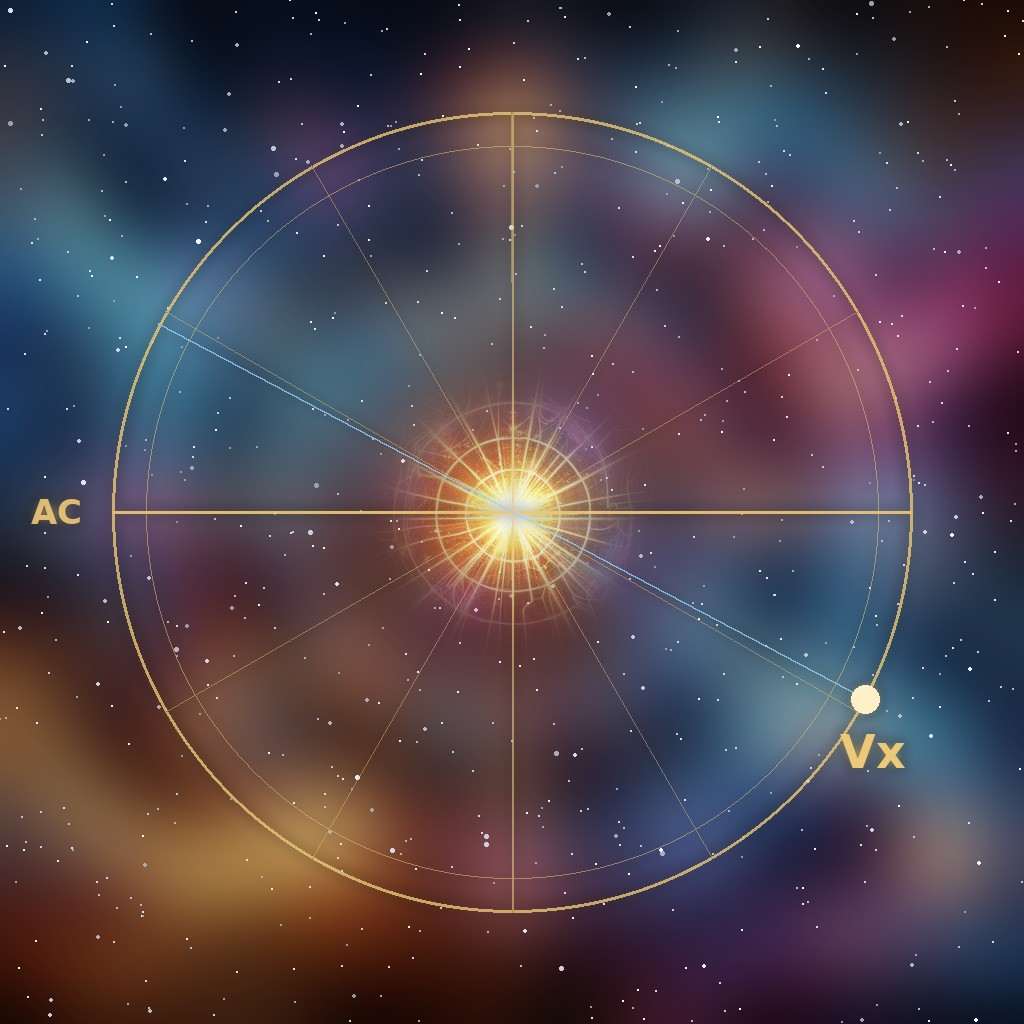
Most guides on Vertex astrology repeat one rule. They say the Vertex always sits in the 5th, 6th, 7th or 8th house of your birth chart. We put that rule to the test. We cast 120,000 US birth charts and found the point of each one. The rule held for 98.5% of them. The other 1.5% were all born in Miami. This guide explains what the Vertex is, how to find yours, why your birth minute matters so much, and how astrologers read it in love and in synastry.
What is the Vertex in astrology?
Picture your birth chart as a house with twelve rooms. Each room covers one part of life, such as love, work or home. The planets are the furniture. The rising sign, called the Ascendant, is the front door on the east side. The Vertex is not a planet. It is a point, a spot marked on the wall, like a nail that holds a picture.
Here is where that spot comes from. Stand outside and face south. Now draw a big circle in the sky. It starts due east, climbs straight over your head and comes down due west. Sky watchers call it the prime vertical. The path the Sun and planets follow across the sky is a second circle, called the ecliptic. The two circles cross at two points. The one on the west side is the Vertex. The one on the east side is its mirror, the anti-vertex.
Charts mark the Vertex with the letters Vx.
Because it sits on the west side, the Vertex lands in the half of the chart that faces other people. The west edge of the chart is the Descendant, the point of partners and close ties. In our sample, the Vertex sat on average 34 degrees from the Descendant. That is one reason astrologers tie it to people who come into your life.
Where the idea comes from
The Vertex is young. Ptolemy, the Greek writer of the second century whose book Tetrabiblos shaped Western astrology, never used it. Neither did the medieval or Renaissance masters. It is a point of the twentieth century.
The first name on it is L. Edward Johndro, a Canadian astrologer and electrical engineer who died in 1951. He wrote about an “electric Ascendant” in the chart. Later, the American astrologer Charles Jayne worked with the same pair of points. He found the western one, the Vertex, more telling in his work with charts. That is the name that stuck. It is also why some books still call this axis the electric Ascendant.
Johndro’s own reading set the tone: a point of fate, the part of the chart you choose least. Modern astrologers still read the Vertex in that spirit. Keep in mind that this is a reading, not a proof. Astrology is a symbolic language, not a science.
What is my Vertex? How to find it without a vertex calculator
You can use any free birth chart site as a vertex calculator. What you cannot skip is good data. You need three facts.
- Your birth date.
- Your birth time, to the minute. US long-form birth certificates list it.
- Your birth place, as a city or town.
- Cast the chart and look in the settings for extra points. Turn on the Vertex. Some sites hide it by default.
- Read the sign and degree next to Vx. A result like “Vx 24° Cancer” means the point is 24 degrees into the sign of Cancer.
- Note the house. Most sites use Placidus houses by default. Placidus is a way of drawing the twelve rooms based on time. If your site uses whole sign houses, each room is exactly one sign. The house can change from one system to the other, as you will see below.
Why the exact minute matters
The Vertex is tied to the turning of the Earth, so it moves fast. We checked how far it moves when the birth time shifts by four minutes. On average it moved one full degree. That average is the same in every US city, because the Earth turns at the same speed everywhere.
The spread is not the same, though. In New York, a four-minute shift moved the Vertex by 0.7 to 2.2 degrees. In Seattle, the range was 0.8 to 1.8 degrees. In Miami, it ran from 0.5 degrees to almost 11 degrees.
So a birth time rounded to the nearest half hour can put your Vertex up to seven or eight degrees off, and more in Florida. That is enough to change its sign. It is enough to break any tight contact you read in synastry. If your time is a guess, treat your Vertex as a guess too.
Is the Vertex always in houses 5 to 8? What 120,000 charts show
The common rule says yes. Here is what we found with Placidus houses, the default on most sites.
| House | Share of US charts (Placidus) |
|---|---|
| 4th house | 0.8% of charts. |
| 5th house | 27.3% of charts. |
| 6th house | 21.9% of charts. |
| 7th house | 22.0% of charts. |
| 8th house | 27.2% of charts. |
| 9th house | 0.8% of charts. |
So the rule holds for 98.5% of charts. All the exceptions came from one city, Miami. One Miami chart in four had its Vertex in the 4th or the 9th house. We then ran the same test at other points on the map. The exceptions stop between 27 and 28 degrees north. Houston, at almost 30 degrees north, gave none at all. Further south, as in Hawaii or Puerto Rico, the rule breaks more and more.
Now the same charts with whole sign houses.
| House | Share of US charts (whole sign) |
|---|---|
| 4th house | 0.1% of charts. |
| 5th house | 14.2% of charts. |
| 6th house | 27.3% of charts. |
| 7th house | 16.8% of charts. |
| 8th house | 27.4% of charts. |
| 9th house | 14.0% of charts. |
| 10th house | 0.1% of charts. |
Here the rule fails for 14.2% of charts. Almost all of them have the Vertex in the 9th house. Why? With whole sign houses, a house starts at the first degree of a sign, not at an exact line. A Vertex in the last stretch of the west side can spill into the next sign, and so into the next room.
So the honest answer is this. The Vertex always sits on the west side of the chart. With Placidus houses and a birth north of 28 degrees, it stays in houses 5 to 8. With whole sign houses, about one chart in seven puts it in the 9th.
Want a refresher on what each room covers? Our guide to the 12 astrological houses walks through all of them.
Vertex by sign: why Leo to Scorpio win
The Vertex does not spread evenly over the twelve signs. Here is the share for each sign in our US sample.
| Vertex sign | Share of US charts |
|---|---|
| Vertex in Aries | 3.2% of charts. |
| Vertex in Taurus | 4.3% of charts. |
| Vertex in Gemini | 7.0% of charts. |
| Vertex in Cancer | 10.8% of charts. |
| Vertex in Leo | 12.3% of charts. |
| Vertex in Virgo | 12.4% of charts. |
| Vertex in Libra | 12.2% of charts. |
| Vertex in Scorpio | 12.4% of charts. |
| Vertex in Sagittarius | 10.8% of charts. |
| Vertex in Capricorn | 7.0% of charts. |
| Vertex in Aquarius | 4.3% of charts. |
| Vertex in Pisces | 3.2% of charts. |
Leo, Virgo, Libra and Scorpio each hold about one chart in eight. Aries and Pisces hold about one in thirty.
The reason is in the math. The Vertex is found the same way as a rising sign, but as if you stood at a mirror latitude. That mirror is 90 degrees minus your own. Seen from far in the north, the zodiac belt rises at a steep slant. Some signs take a long time to clear the skyline and others shoot up fast. Our guide to the Ascendant explains this slant for the rising sign.
Here is the twist. Miami sits at 25.8 degrees north, so its mirror is 64 degrees north, near the Arctic. That makes Miami the most lopsided city in our sample. There, the Vertex was in Scorpio for 15.9% of charts and in Aries or Pisces for only 0.8% each. Seattle sits at 47.6 degrees north, so its mirror is a mild 42 degrees. There, Aries and Pisces each reached 4.6%, and no sign passed 11.1%. For the Vertex, the farther south you are born, the more it crowds into Leo through Scorpio.
Where is the Vertex right now?
There is no single Vertex of the moment. A planet like Venus is in the same sign for everyone on Earth at a given time. The Vertex is not. It depends on where you stand and on the minute.
Here is a worked case. On October 4, 2026, at 12:00 noon in New York (16:00 UTC), the Vertex stood at 24°19′ Cancer. It sat in the 8th house with both Placidus and whole sign houses. The Ascendant was 10°34′ Sagittarius. Four minutes later, at 12:04 pm, the Vertex had moved to 25°05′ Cancer.
At that same instant, the Vertex for Los Angeles stood at 25°15′ Gemini. For Miami, it was 5°46′ Leo. One moment, three cities, three different signs. The anti-vertex for New York sat at the exact opposite point, 24°19′ Capricorn.
What the Vertex means: the reading in practice
Modern astrologers who use the Vertex read it as a point of meetings you did not plan. Think of a stranger on a train who changes your path, or a job offer that arrives out of the blue. The sense is of something that comes to you rather than something you chase. The house and the sign of the Vertex color what kind of meeting it is and where it happens.
Here is how the four main houses are read in that tradition.
- Vertex in the 5th house. The 5th house is the room of play, romance, art and children. With the Vertex here, the key meetings come through fun, a crush, a creative project or a child. It was the most common Placidus house in our sample, at 27.3%.
- Vertex in the 6th house. The 6th house is the room of daily work and routine. The turning point comes through a job, a coworker or a habit you build.
- Vertex in the 7th house. The 7th house is the room of partners, both in love and in business. This is the placement most tied to the idea of a fated partner. Our page on the seventh house meaning covers that room in depth. In our sample, 22.0% of charts had the Vertex there with Placidus houses.
- Vertex in the 8th house. The 8th house is the room of shared money, trust and deep change. The meetings here are intense, and they change what you hold or what you fear.
The Vertex works best as a detail, not as the headline of a chart. The planet that rules your rising sign says far more about you. Our page on the chart ruler shows how to find it.
The anti-vertex: the eastern twin
The anti-vertex, marked Avx, is the point exactly opposite the Vertex. It sits on the east side, the side of the self. If your Vertex is at 24 degrees Cancer, your anti-vertex is at 24 degrees Capricorn.
Astrologers read the pair as an axis, a line through the chart. The Vertex end is what comes to you from others. The anti-vertex end is what you bring to that meeting on your own. Charles Jayne found the western end the more telling of the two, and most modern work follows him. A planet sitting right on the anti-vertex can show what you put into those turning points.
Vertex synastry: when two charts meet
Synastry means laying two birth charts side by side to see how two people connect. For a deeper look at the method, see our guide to synastry charts.
In synastry, the Vertex comes alive when a planet in one chart sits on the Vertex in the other. Astrologers call that a conjunction: two points at the same degree, or close to it. The most read contacts are the other person’s Sun, Moon, Venus or Ascendant on your Vertex. The person with the planet arrives. The person with the Vertex feels the jolt of the meeting.
Keep the window small. The gap astrologers allow around an exact contact is called the orb. Because the Vertex moves about one degree every four minutes of birth time, a wide orb means little. Those who work with this point keep the orb to a degree or two, and only trust it when both birth times are exact.
A Vertex contact describes the meeting, not the length of the bond. In the tradition, it is the spark that brings two people into the same room. Whether they stay is read from the rest of the two charts. Juno is one of the points astrologers check for that side, as our page on Juno and the bond you commit to explains.
Can the Vertex show a soulmate?
Not on its own, and not as a promise. In the tradition, a Vertex contact marks a meeting that feels fated. It says nothing about whether that person is right for you, or whether the tie will last. Some Vertex meetings are brief lessons. A soulmate, if you hold to that idea, is something you build over time with a real person. No point on a chart can sign that for you.
How we counted
Here is the method, so you can check our numbers.
- We drew 120,000 moments at random between 1950 and 2010. Each moment was equally likely. We did not weight them by the real hours when babies are born.
- For each moment, we drew one of 16 large US cities: New York, Los Angeles, Chicago, Houston, Phoenix, Philadelphia, San Antonio, San Diego, Dallas, Seattle, Miami, Denver, Minneapolis, Boston, Atlanta and Detroit.
- We used the Swiss Ephemeris, a standard star table used by most chart programs. The zodiac is the tropical one, the one Western astrology uses. All times are in UTC.
- We placed the Vertex in Placidus houses and in whole sign houses.
- For the speed test, we cast each chart a second time, four minutes later, and measured the gap.
- To find where the exceptions stop, we ran 20,000 moments at each of ten latitudes from 20 to 30 degrees north.
We also checked the Vertex itself by a second, separate route. On 1,000 random charts, we found by hand the point where the ecliptic crosses the due-west circle. It matched the Swiss Ephemeris value every time.
The sign shares come from the turning of the Earth, not from the slow planets. So the time window does not change them in any real way. The city does, as the Miami and Seattle numbers show.
Vertex astrology FAQ
What is my Vertex?
Your Vertex is the point in the west of your birth chart where the path of the planets crosses the circle that runs due east to due west over your head. To find it, cast your chart with your exact birth date, birth time and birth place. Turn on the Vertex in the chart settings and read the sign and degree next to Vx.
Can the Vertex indicate soulmates?
Not on its own. In the tradition, a Vertex contact in synastry marks a meeting that feels fated. It does not say whether the bond will last or whether it is good for you. Read it with the rest of both charts, and only with exact birth times.
What is the Vertex symbol (Vx)?
Vx is the short mark for the Vertex on a chart wheel. Some charts also show Avx for the anti-vertex, the point exactly opposite.
Where is the Vertex right now?
There is no single Vertex for everyone. It depends on your place and on the minute. On October 4, 2026, at noon in New York (16:00 UTC), it stood at 24°19′ Cancer. At the same instant it was 25°15′ Gemini for Los Angeles and 5°46′ Leo for Miami.
How is the Vertex calculated?
The Vertex is the western crossing of two circles in the sky: the ecliptic, the path of the Sun and planets, and the prime vertical, the circle through due east, overhead and due west. In practice, chart programs find it the same way as a rising sign, but for a mirror latitude of 90 degrees minus your own. It moves about one degree for every four minutes of birth time.
Go deeper with your personal Astrovision report
Reading about astrological concepts is a great start, but nothing compares to hearing how they apply directly to you. Our users love our audio-first approach, calling it “friendly, personal, and easy to understand.” While this article gives you the “what,” a personal report gives you the “so what.” Discover your unique path with an Astrovision report—your personal ‘user manual’ delivered in our celebrated podcast format.