
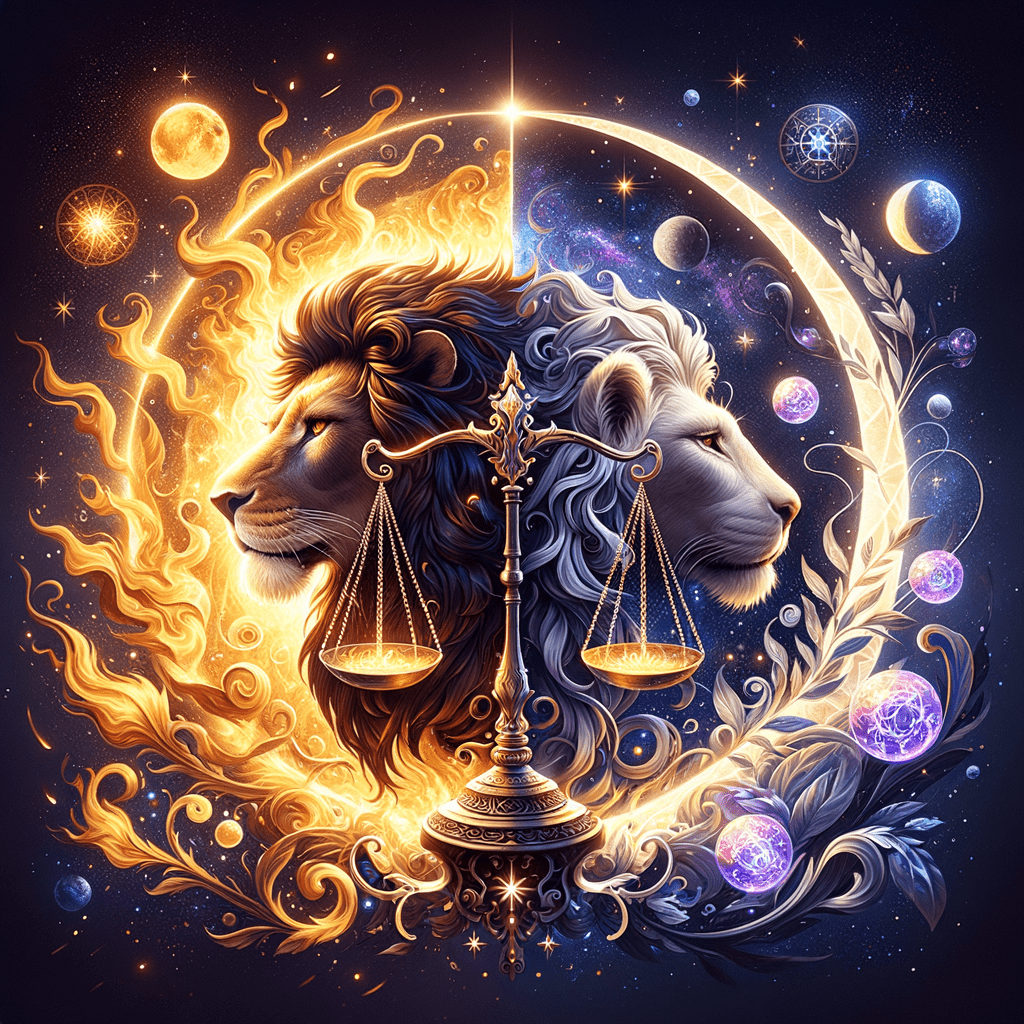
Leo Moon and Libra Moon compatibility sets two signs with a strange tie to the Sun side by side. Leo is the only sign the Sun rules. Libra is the sign where the old books say the Sun falls, its weakest place in the zodiac. So one partner has the Moon in the Sun’s home, and the other has it in the Sun’s low point.
That sounds like a clash. It is not quite one. The two signs sit two apart, in a friendly angle called a sextile. This page walks through the old rules, the sky facts we measured, and what they mean for a couple.
The short version
| Question | Answer. |
|---|---|
| What angle do the signs form? | A sextile, two signs or 60 degrees apart. |
| Elements and modes? | Fire and air, fixed and cardinal. |
| Who rules each sign? | The Sun rules Leo, Venus rules Libra. |
| Where is the Sun strong or weak? | At home in Leo, in its fall in Libra. |
| Rank of each Moon? | No rank in either sign. |
| Any special bond in Ptolemy? | None, on either way of reading him. |
| How common is the couple? | About 1 couple in 72, like any mixed pair. |
A word of honesty first
Astrology is not a science. No study has shown that Moon signs predict how a couple will do. The biggest test of love signs came from the sociologist David Voas in 2007. He used the 2001 census of England and Wales, with 10.3 million married couples. He found no effect of Sun signs on who marries whom.
A census has no birth times, so no one can run that test on Moon signs. Read this page as a guide to old ideas and real sky facts. It can start a good talk. It cannot grade your couple.
The Sun’s home and the Sun’s fall
Ptolemy wrote the Tetrabiblos in Alexandria around 150 AD. In Book 1, chapter 17, he hands out the signs to the planets. The Sun gets one sign, Leo. The Moon gets one sign, Cancer. Each other planet gets two, and Venus takes Taurus and Libra.
Two chapters later, he adds a second layer, the exaltations. A planet is exalted where it is at its best. It falls in the opposite sign, where it is at its worst. The Sun is exalted in Aries, where the days start to grow longer than the nights. It falls in Libra, where the days start to shrink. Saturn, the cold planet, takes Libra as its place of honor instead.
Ptolemy also built a pattern into these homes. Venus has one home a sextile from the Sun’s, and one a sextile from the Moon’s. Libra is a sextile from Leo. Taurus is a sextile from Cancer. So the angle in this couple is the very angle that ties Venus to the Sun.
So Libra is a sign where the Sun has no power. It belongs to Venus, the planet of taste, beauty and fair shares. Leo is the one place where the Sun rules alone.
In a chart, the Moon stands for needs, moods and what feels safe. The Moon in Leo takes its cue from the Sun. It needs warmth, pride and a clear place in the spotlight. The Moon in Libra takes its cue from Venus. It needs calm, fairness and a partner who meets it halfway.
Read that way, this couple joins a Moon that wants to shine with a Moon from the sign where shining is not the point. In Libra, the self steps back so the pair can stand in front.
Two Moons with no rank
The old books also rate the Moon itself in each sign. The Moon rules Cancer, is exalted in Taurus, and is weak in Capricorn and Scorpio. Leo and Libra are on none of those lists.
William Lilly, in Christian Astrology in 1647, called a planet with no rank in its sign peregrine. The word means a traveler far from home. A peregrine Moon is not weak. It simply leans on the planet that owns the sign it is in.
That is why the rulers matter so much here. Our guide to the Moon in Leo says this Moon needs a witness more than a crowd. Our guide to the Moon in Libra looks at the Moon that seeks balance. Put them side by side and you get the Sun and Venus, talking through two Moons.
A sextile, and what it means
In Book 1, chapter 13, Ptolemy names four links between signs. They are the opposition, the trine, the square and the sextile. The sextile joins signs two apart, at 60 degrees. He calls it a friendly link, because both signs are of the same kind.
Here, both signs are what the old books call masculine: fire and air. Fire is warm, quick and bold. Air is light, social and curious. Air feeds fire, and fire gives air something to carry. Modern astrologers such as Stephen Arroyo read fire and air as a lively mix, full of talk and plans.
Fixed meets cardinal
The mode of a sign says how it moves. Leo is fixed, which means it holds on once it has chosen. Libra is cardinal, which means it starts things. Libra opens the autumn season, with the September equinox.
Among the 78 Moon pairs, only two are fire and air sextiles that join a fixed sign to a cardinal one. This couple is one. Aries and Aquarius is the other.
In daily life, the Libra Moon starts the talk, the plan or the peace deal. The Leo Moon commits and then stays loyal. Trouble comes when the Libra Moon keeps weighing a choice the Leo Moon has already made. The Leo Moon reads that as doubt. The Libra Moon reads the Leo Moon’s firmness as a refusal to listen.
What Ptolemy did not link
Ptolemy had two more bonds between signs, in chapters 14 and 15. Some signs command and others obey. Some signs see each other, as equals. Modern readers count these bonds in two ways, and the lists do not match.
Read by exact degree, as mirror images across the start of Aries or Cancer, the bonds follow what William Lilly called antiscia. On that reading, Leo commands Scorpio and sees Taurus. Libra obeys Virgo and sees Pisces.
Read by whole signs, as in the notes of the translator Frank Robbins, the lists shift by one sign. Leo commands Sagittarius and sees Gemini. Libra sits outside the command scheme and sees Aries.
So Leo and Libra share no such bond, on either reading. They are not cut off either. Ptolemy called signs disjunct when they are one or five signs apart. By whole signs, 24 pairs are disjunct. By degree, 16 are. Two signs apart, this couple is in neither group. The plain sextile is its only classical link.
What we measured: new moons and full moons
Every Moon sign spends close to the same time in the sky, between 8.33 and 8.34 percent. So no Moon pair is rare. Any mixed pair comes out at about 1 couple in 72. A pair of the same sign is 1 couple in 144.
One real gap does show up by sign. It is about the phase of the Moon at birth. A person born near a new moon has the Moon in the same sign as the Sun. A person born near a full moon has the Moon in the sign opposite the Sun.
| Moon sign | New moon type, Sun in the same sign | Full moon type, Sun in the opposite sign. |
|---|---|---|
| Leo Moon | 8.43 percent, with a Leo Sun | 7.96 percent, with an Aquarius Sun. |
| Libra Moon | 8.19 percent, with a Libra Sun | 8.20 percent, with an Aries Sun. |
The Leo Moon leans toward the new moon. The Earth is farthest from the Sun in early July, so the Sun moves slowest in the northern summer. It lingers in Leo, which leaves more time for a new moon there.
The Libra Moon splits almost even. Libra and Aries sit at the two equinoxes, where the Sun moves at a middle pace. So neither phase wins.
For the couple, 15.93 percent include at least one partner born with the Moon in their own Sun sign. In 15.51 percent, at least one was born near a full moon. The gap is small but real. It shows up on both routes we used to check it.
In the old reading, a Leo Sun with a Leo Moon has one clear voice. Self and needs point the same way. If one of you is born that way, the call for warmth and praise is twice as loud. Our guide to moon phase compatibility shows how to find your own phase.
How close are the two Moons in degrees?
An angle by sign is not always exact in degrees. Astrologers allow a margin around the exact angle, called an orb. The Moon moves at a near even pace through each sign, so plain geometry gives the share of couples inside each orb.
| Orb allowed | Couples with a true 60 degree angle. |
|---|---|
| Within 3 degrees | 19 percent of couples. |
| Within 6 degrees | 36 percent of couples. |
| Within 8 degrees | 46 percent of couples. |
| Within 10 degrees | 56 percent of couples. |
These shares are the same for every Moon pair. They come from geometry, not from Leo or Libra. One edge case is special to this pair. An early Leo Moon and a late Libra Moon can sit close to 90 degrees apart. That is a real square hidden inside a sextile by sign. At an 8 degree orb, it happens in 3.56 percent of couples.
Check both Moons before you read
A reading needs two correct Moon signs. The Moon stays in a sign for 54.6 hours on average, from 46.9 to 61.1 hours. It changes sign on 43.92 percent of all days. A birth on such a day has two possible Moons.
Tools with no birth time use noon. That guess gives the wrong Moon sign in 10.98 percent of charts. For a couple, it gives the wrong pair in about 1 case in 5, or 20.75 percent. Only 31 percent of couples have both Moons fixed by the date alone. Our main page on Moon sign compatibility gives the full count.
This pair has its own trap. A late Leo Moon can turn out to be an early Virgo Moon. An early Libra Moon can turn out to be a late Virgo Moon. The birth time settles it.
Sun, Moon and Venus: three different pairs
The same two signs mean different things for each planet. Our page on Leo and Libra Sun sign compatibility looks at the core self and how the rulers link. Our page on Venus in Leo and Venus in Libra looks at how each partner loves and shows taste.
The Moon pair is about comfort. It shows what each of you needs after a hard day. A couple can share a Moon pair and have very different Suns. It is worth reading all three before drawing any line.
Three talks worth having
- How do you like to be loved? The Leo Moon needs praise it can hear. The Libra Moon needs fairness it can feel. Say which one you need, out loud.
- Who decides, and when? The Libra Moon wants to weigh every side. The Leo Moon wants to choose and move on. Agree on a time limit for big choices.
- How do you fight? The Libra Moon hates open conflict and goes quiet. The Leo Moon hates being ignored and gets loud. Name the pattern when it starts.
For another fire and air sextile with a Leo Moon, see Gemini Moon and Leo Moon compatibility. For a Libra Moon in an air trine, see Gemini Moon and Libra Moon compatibility.
How we measured
We used two separate routes over the years 1600 to 2400, with every moment weighted the same. Route one used the astronomy-engine library. It found each sign change of the Moon and the Sun to within a tenth of a second, then added up the exact time in each case. Route two used the Swiss Ephemeris and checked the sky once an hour, on a grid shifted by half an hour. The two routes agree to within 0.05 points.
The noon test uses calendar days in Greenwich time, with a chart at 12:00. For the old rules, we read the Tetrabiblos, Book 1, chapters 13 to 19, in the Robbins translation, and Lilly’s Christian Astrology.
Frequently asked questions
Are a Leo Moon and a Libra Moon compatible?
Astrology reads them as a friendly sextile of fire and air. One needs praise, the other needs fairness. No study has shown that Moon signs predict how a couple does, so use the reading as a lens, not a verdict.
Why is Libra called the Sun’s fall?
Ptolemy put the Sun’s exaltation in Aries, where the days start to lengthen. The opposite sign, Libra, is its fall, where the days start to shrink. Leo is the Sun’s home.
Is the Moon weak in Leo or in Libra?
No. The Moon has no rank in either sign, which tradition calls peregrine. It leans on the ruler of the sign, the Sun for Leo and Venus for Libra.
Does Ptolemy link Leo and Libra in any special way?
Only through the sextile. They do not command, obey or see each other, whether you count by degree or by whole sign. They are not disjunct either.
Can I find my Moon sign from my birth date?
On 56 percent of days, yes, since the Moon stays in one sign all day. On the other days, you need a birth time. A noon guess is wrong in about 1 chart in 9.
Go deeper with your personal Astrovision report
Reading about astrological concepts is a great start, but nothing compares to hearing how they apply directly to you. Our users love our audio-first approach, calling it “friendly, personal, and easy to understand.” While this article gives you the “what,” a personal report gives you the “so what.” Discover your unique path with an Astrovision report—your personal ‘user manual’ delivered in our celebrated podcast format.