
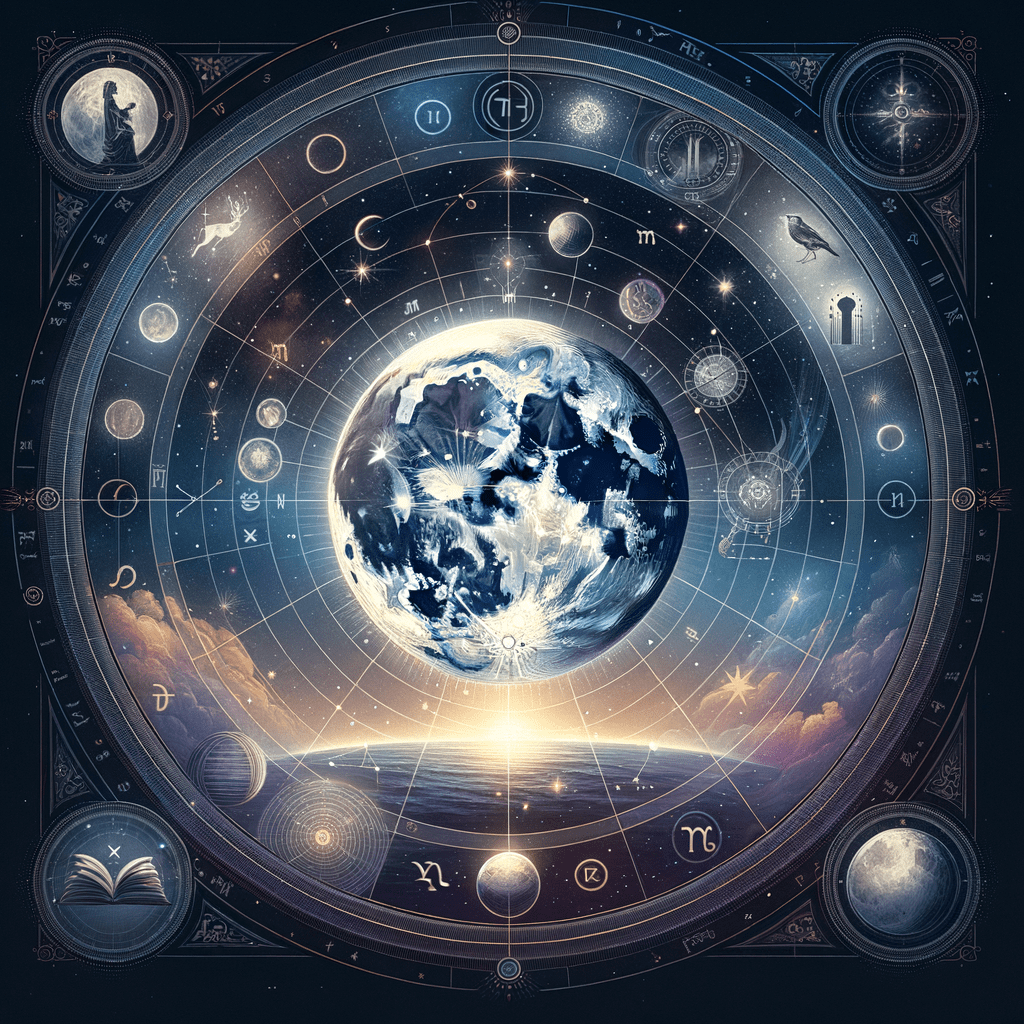
If your Moon is in the 9th house, the Moon was up in the sky when you were born. It had just passed the highest point of its path and was starting down toward the west. That high point is called the meridian. It is the line that runs from due south, over your head, to due north. With the house system most US apps use, the Moon crossed that line less than about three hours before your birth.
So a 9th house Moon is a Moon near its peak. But how high is that peak? It is not the same for everyone. We measured it for New York, over every birth moment from 1940 to 2030. A 9th house Moon can stand as low as 17 degrees above the horizon. It can also stand at 78 degrees, which is higher than the Sun ever gets over New York. Two things set the height: the Moon’s sign, and the year you were born. The year matters because of an 18.6-year cycle that peaked in 2024 and 2025. This guide gives the numbers, the clock times, and what the old and new books say. The method is at the end, so you can check it.
Where a 9th house Moon sits in the sky
Your birth chart is a map of the sky at the minute you were born. Astrologers cut that map into twelve slices called houses. Each house covers one part of life. The 9th house covers long trips, foreign places, higher study, faith, law and books. Our guide to 9th house astrology, the house of luck you have to earn sets out the whole room.
Now picture how the sky turns. A point of the zodiac rises in the east. It climbs through the 12th, 11th and 10th houses. At the end of the 10th house, it reaches the meridian, the top of its path. Then it starts down. It sinks through the 9th, 8th and 7th houses, and sets in the west.
So the 9th house is the first room after the peak. A Moon there has just gone over the top. It still stands high, a little west of south. The Moon in the 10th house is the one still on the way up. Our guide to the Moon in the 10th house covers that case. One Moon climbs to the top. The other has just passed it.
There are two common ways to cut the sky into houses. Whole sign houses give each house one full sign, counted from the sign rising at birth. Placidus houses cut the sky by time, and most US apps use them. With Placidus, the 9th house is the first third of the time a point spends between the top of the sky and the western horizon. In New York, that third lasts from about one and a half hours to almost three.
With whole signs, the 9th house is simply the ninth sign from your rising sign. The Moon there is still above the horizon. But it can sit a little before or a little after its peak. The heights below use Placidus, since that is the system tied to the peak.
How high was your Moon? New York, sign by sign
The Moon travels close to the path of the Sun. So it rides high in the same signs where the summer Sun rides high. Those are Gemini and Cancer. It rides low in the signs of the winter Sun, Sagittarius and Capricorn. The 9th house only shows the Moon near the top of its path. So the sign sets the height in a very direct way.
We checked every 5 minutes from 1940 to 2030 in New York. Each time the Moon sat in the Placidus 9th house, we noted its height above the horizon. Height is measured in degrees. The horizon is 0 degrees. The point straight over your head is 90 degrees.
| Moon sign | Height of a 9th house Moon in New York | Average height. |
|---|---|---|
| Aries | 37 to 65 degrees | 51 degrees. |
| Taurus | 45 to 74 degrees | 60 degrees. |
| Gemini | 50 to 78 degrees | 64 degrees. |
| Cancer | 48 to 78 degrees | 65 degrees. |
| Leo | 43 to 74 degrees | 60 degrees. |
| Virgo | 35 to 65 degrees | 51 degrees. |
| Libra | 27 to 54 degrees | 41 degrees. |
| Scorpio | 19 to 42 degrees | 31 degrees. |
| Sagittarius | 17 to 33 degrees | 25 degrees. |
| Capricorn | 17 to 33 degrees | 25 degrees. |
| Aquarius | 20 to 42 degrees | 31 degrees. |
| Pisces | 28 to 53 degrees | 40 degrees. |
Read the top and bottom of the range. A 9th house Moon in Sagittarius or Capricorn never climbs past 34 degrees over New York. That is about the height of the noon Sun in early February. A 9th house Moon in Gemini or Cancer never sinks below 48 degrees. The two groups do not overlap at all.
Across all signs, the average 9th house Moon stood at 48 degrees. One in four stood higher than 60 degrees. About one in six stood lower than 30.
The season and the phase work together here. A full Moon sits across the sky from the Sun. So a full Moon in December is in Gemini or Cancer, and it rides high. A full Moon in June is in Sagittarius or Capricorn, and it rides low. A baby born on a December night under a full Moon in the 9th house had the Moon high overhead. A baby born on a June night under the same phase had it low in the south.
The 18.6-year swing: why your birth year changes the height
The Moon’s path is tilted by about 5 degrees against the path of the Sun. That tilt slowly turns around. It takes 18.6 years to come back to the same place. The two points where the Moon’s path crosses the Sun’s path are called the lunar nodes. Astrologers know them as the North Node and the South Node. Their slow turn is what drives this cycle.
When the tilt adds to the Sun’s own range, the Moon swings extra far north and extra far south. That peak is called a major lunar standstill. The last one fell in 2024 and 2025. When the tilt works against the Sun’s range, the Moon’s swing is narrow. That is a minor standstill. The last was in 2015, and the next comes in 2034.
For a 9th house Moon, this changes the ceiling and the floor. We looked at the top of the Moon’s path in New York, year by year.
| Birth years | Highest a 9th house Moon got | Lowest it got. |
|---|---|---|
| Near a major standstill: 1950, 1969, 1987, 2006, 2025 | About 78 degrees | About 17 degrees. |
| Near a minor standstill: 1959, 1978, 1997, 2015 | About 67 to 68 degrees | About 26 degrees. |
The Sun at noon on the longest day of the year stands at 72.7 degrees over New York. That is as high as the Sun ever gets there. In some birth years, the Moon can top it. In others, it never comes close.
Here is the count. From 1940 to 2030, 2.5 percent of all 9th house Moons in New York stood higher than the Sun’s highest noon. But that share was zero in 39 of the 91 years. It was zero from 1940 to 1944, 1956 to 1963, 1974 to 1982, 1993 to 2000, 2012 to 2019, and in 2030. In the years close to a major standstill, it rose to between 6 and 8 percent.
The gap is wider if you look at the high signs only. Take the 9th house Moons in Gemini and Cancer born from 2023 to 2027. Of those, 29 percent stood higher than the summer Sun ever does. For the same signs born from 2013 to 2017, the share was zero. The highest any of them got was 70 degrees.
Here is one real case. On April 3, 2025, the Moon crossed the meridian over New York at 6:04 p.m. EDT, which is New York summer clock time. It stood 77.8 degrees above the horizon. That is five degrees above the Sun’s best. The Moon then sat in the Placidus 9th house until 8:39 p.m. EDT, sinking to 57 degrees by the end. A baby born in that window has a 9th house Moon in Gemini, near the highest it can be. For a contrast, take the full Moon of Christmas Eve, 2034. Its 9th house window in New York runs from 11:46 p.m. to 2:21 a.m. EST, and its peak is only 67.4 degrees.
The same Moon over other US cities
The farther south you go, the higher the Moon climbs. Here is the highest the Moon got at its peak in 2025, near the major standstill. We add 2034, at the minor standstill, and the Sun’s highest noon for each city.
| City | Moon’s best in 2025 | Moon’s best in 2034 | Sun’s best, any year. |
|---|---|---|---|
| Miami | 90 degrees | 83 degrees | 88 degrees. |
| Los Angeles | 84 degrees | 74 degrees | 79 degrees. |
| New York | 78 degrees | 67 degrees | 73 degrees. |
| Chicago | 77 degrees | 66 degrees | 72 degrees. |
| Seattle | 71 degrees | 60 degrees | 66 degrees. |
Outside Miami, the Moon of 2025 beats the Sun by about five degrees. In every city, the Moon of 2034 falls short of the Sun by about five. In Miami in 2025, the Moon passed within a tenth of a degree of the point straight overhead. A 9th house Moon starts at that peak and sinks from there, so these are the ceilings.
What time you were born: the phase sets the clock
The Moon reaches the top of the sky about 50 minutes later each day. So the clock time of a 9th house Moon depends on the phase on your birthday. The phase is the angle between the Moon and the Sun. At new Moon, the Moon sits next to the Sun, so it peaks with the Sun around midday. At full Moon, it sits across the sky from the Sun, so it peaks around midnight. The first quarter peaks near dusk, and the last quarter near dawn.
A 9th house Moon has just passed that peak. So each phase has its own birth hours. We took every 9th house Moon in New York from 1940 to 2030 and noted the local clock time, with summer time where it applied.
| Phase at birth | When the Moon peaks | Most 9th house Moon births, New York clock. |
|---|---|---|
| New Moon | With the Sun, around midday | 11 a.m. to 3 p.m. |
| Waxing crescent | Mid afternoon | 2 p.m. to 6 p.m. |
| First quarter | Near dusk | 5 p.m. to 9 p.m. |
| Waxing gibbous | Late evening | 9 p.m. to midnight. |
| Full Moon | Around midnight | Midnight to 3 a.m. |
| Waning gibbous | In the small hours | 2 a.m. to 6 a.m. |
| Last quarter | Near dawn | 5 a.m. to 9 a.m. |
| Waning crescent | Mid morning | 8 a.m. to noon. |
The last column holds the shortest span of whole hours that covers 80 percent of cases. The rule is easy to use. A full Moon baby with a 9th house Moon was born in the small hours after midnight. A new Moon baby was born around lunch. A last quarter baby was born around breakfast.
The phase does not change the height much. Over New York, the average 9th house Moon stood at 47 to 48 degrees in every phase. The sign and the year do that work, as the tables above show.
How common is it? One in twelve, until the hospital clock
Over many years, the Moon passes through the 9th house for about one twelfth of every day. So if babies came at the same rate every minute, one chart in twelve would have this Moon. That is 8.33 percent.
We checked this for the whole country. We took every 10 minutes from 1940 to 2030 and cast a chart for 303 places across the United States, weighted by the number of people who live there. With an even clock, the Moon sat in the 9th house in 8.33 percent of charts with Placidus, and 8.34 percent with whole signs.
But babies do not come at an even pace. The CDC, the US public health agency, puts every birth record into one public file each year. The CDC natality file 2024 holds 3,638,436 births, each with its clock time. The busiest hour is 8 a.m. to 9 a.m., with 6.3 percent of all births. Planned C-sections peak right then. The quietest stretch runs from 2 a.m. to 7 a.m., at about 3 percent an hour.
We weighted every chart by the real 2024 birth hour, month and day of the week. The total barely moved, to 8.34 percent with both house systems. Each phase takes every hour in turn, so the busy and quiet hours cancel out. Split the count by phase, and the hospital clock shows up at once.
| Phase at birth | 9th house Moon, Placidus | 9th house Moon, whole sign. |
|---|---|---|
| New Moon | 10.2 percent of births | 9.9 percent of births. |
| Waxing crescent | 9.3 percent of births | 8.8 percent of births. |
| First quarter | 7.9 percent of births | 7.7 percent of births. |
| Waxing gibbous | 7.1 percent of births | 6.8 percent of births. |
| Full Moon | 6.3 percent of births | 6.3 percent of births. |
| Waning gibbous | 6.1 percent of births | 6.7 percent of births. |
| Last quarter | 9.2 percent of births | 10.1 percent of births. |
| Waning crescent | 10.5 percent of births | 10.5 percent of births. |
With an even clock, every row would read 8.3 percent. We checked, and it does, within 0.1 points. With real birth hours, the rows spread far apart.
A baby born near a waning crescent Moon has 10.5 percent odds of a 9th house Moon with Placidus. That Moon peaks in mid morning, so its window runs from about 8 a.m. to noon. Those are the busiest hours on the hospital clock. A baby born near a waning gibbous Moon has 6.1 percent odds. That window falls in the small hours, when few births are planned. The gap is 1.7 to one.
Put the last quarter, the waning crescent and the new Moon together. They cover 37.5 percent of US births, but 44.9 percent of all 9th house Moons. The full Moon and the waning gibbous cover 24.8 percent of births, but only 18.5 percent of 9th house Moons. The Moon high in the night sky is the rarer case in American charts.
Compare the Moon in the 6th house, which had just set. For that Moon, the full and waning phases lead, because they set in the morning rush. For the 9th house, the same morning rush favors the last quarter and the waning crescent. Our guide to the Moon in the 6th house gives those numbers.
The Moon in the house of God
The Greek astrologers gave each house a name. They called the 9th house Theos, which means God. They called the 3rd house, straight across the chart, Thea, which means Goddess. Vettius Valens, a working astrologer of the second century, linked the 9th house with travel abroad and the gods in his Anthologies.
The Greeks also gave each planet a joy, a house where it was said to rejoice. The list comes from Paulus Alexandrinus and from Firmicus Maternus. Mercury rejoiced in the 1st house, the Moon in the 3rd, Venus in the 5th and Mars in the 6th. The Sun rejoiced in the 9th, Jupiter in the 11th and Saturn in the 12th.
So a 9th house Moon sits in the Sun’s joy, the house of God. Her own joy, the house of the Goddess, is the room straight across from it. The Moon has crossed the chart to the Sun’s side. Chris Brennan, in his book Hellenistic Astrology, treats these joys as one of the oldest layers of house meaning.
The 9th house is also a falling place. The Greeks called it a decline, and Latin writers said cadent, from a word for falling. A planet there has just passed one of the four angles. Here that angle is the top of the sky. The picture fits the sky. The Moon has reached the peak and has begun to fall away.
Ptolemy, writing in Alexandria in the second century, used that very picture. In his Tetrabiblos, in the chapter on travel, he looks to the Moon first. When the Moon is setting or falling away from the angles, he says, she points to journeys and changes of place. A 9th house Moon has just fallen away from the top. For Ptolemy, that is a Moon on the move.
William Lilly, in Christian Astrology in 1647, gave the 9th house long voyages by sea, religion, the clergy, dreams and visions. He gave the Moon women, the common people, and travellers. Put the two together, and the old reading of a 9th house Moon is plain. Home life leans toward far places, faith, and a restless search for meaning.
How this Moon shows up in a life
Here the counting stops and the reading starts. Modern astrologers read the Moon as your needs. Stephen Arroyo reads it as the need for comfort and emotional safety. Liz Greene and the psychological school she led from the 1970s read the houses as parts of the inner life as well as the outer one. Robert Hand, in Horoscope Symbols, gives each house a field of daily life. Put that together with the old names, and you get these themes. They are a starting point, not a verdict.
Distance feels safe. This Moon calms down in a new place, not in the same room. A trip, a move, or a foreign language can feel like coming home. Staying put too long can feel like a low mood that has no name.
Meaning is a need, not a hobby. People with this Moon need a story that makes sense of life. That can be a faith, a school of thought, or a cause. When the big picture falls apart, the feelings fall with it.
Learning is comfort. A class, a long book or a hard new subject soothes this Moon. Many of them are the family member who kept studying after everyone else stopped.
Home has a far edge. The old books tie the Moon to the mother and the 9th house to foreign lands and in-laws. So modern writers link this Moon to a family with roots elsewhere, a parent who taught, or close ties with a partner’s family.
The height adds a layer of its own. One way to read it: a high Moon shows feelings worn in plain view, since the Moon stood where anyone could see it. A low Moon in the same house, down near the southern horizon, shows the same need held closer and quieter. That is our own reading, not a rule from the old books. The Greek authors read the Moon by her phase, sign and house, not by her height. Demetra George, who translates and teaches those sources, puts the phase first. We give the height because it is a real fact of the sky at your birth.
The Moon keeps moving after birth. One room down is the 8th house, and our guide to the Moon in the 8th house follows the same Moon as it sinks toward the west.
How to check your own chart
You need three facts: your birth date, your birth time and your birth town. For this Moon, the time is the key. The Placidus window lasts about two hours. A birth time that is off by an hour can move the Moon into the 10th house or the 8th.
Birth certificates in the United States list the time on the local clock. That includes daylight saving time in summer. The sky follows the Sun, not the clock. So solar time and clock time can differ by an hour or more. A good chart program converts from one to the other for you. Enter the time as it is written on the certificate.
Then check the house system. Most apps offer both Placidus and whole signs. If both put your Moon in the 9th house, the reading is firm. If only one does, read both houses and see which one sounds more like you. Our guide to the whole sign house system shows how to count it by hand.
Last, find the height. Most sky apps and planetarium programs show the Moon’s height for any date, time and place. Enter your birth details and look at the Moon. Then check the year against the table above. A birth year near 1950, 1969, 1987, 2006 or 2025 gives the widest range of heights. A birth year near 1959, 1978, 1997 or 2015 gives the narrowest.
Questions people ask about the Moon in the 9th house
What does it mean to have the Moon in the 9th house?
It means the Moon had just passed the top of its path when you were born. It stood high in the sky, a little west of south. In astrology, it ties your feelings to travel, study, faith and the search for meaning.
Was the Moon visible when I was born with a 9th house Moon?
It was above the horizon, in both house systems. Whether you could see it depends on the phase and the daylight. A thin Moon near the Sun is hard to see by day. A full Moon in the 9th house is a bright Moon high in the night sky.
How high was the Moon in the 9th house?
In New York, from 17 to 78 degrees above the horizon. The sign sets most of it. Gemini and Cancer are the highest, Sagittarius and Capricorn the lowest. The birth year sets the rest, through the 18.6-year cycle of the lunar nodes.
How rare is the Moon in the 9th house?
It is not rare. With births spread evenly over the day, it is one chart in twelve. With real US birth hours from 2024, the total stays at 8.34 percent. The odds do change with the phase, from 6.1 percent near a waning gibbous Moon to 10.5 percent near a waning crescent.
Is the 9th house the joy of the Moon?
No. The 9th house is the joy of the Sun and was called the house of God. The Moon rejoices in the 3rd house, the house of the Goddess, straight across the chart.
How we measured it
We used pyswisseph, a Python version of the Swiss Ephemeris, with its built-in Moshier tables. For New York (40.71 degrees north, 74.01 degrees west), we stepped through time every 5 minutes from 1 January 1940 to 31 December 2030, in Universal Time. That is about 9.6 million moments.
A Moon is in the Placidus 9th house when its point on the zodiac crossed the meridian less than a third of its time above the horizon ago. We wrote that rule ourselves. For the height, we used the real Moon, not its point on the zodiac, since the real Moon can sit up to five degrees off the Sun’s path. We took the height as seen from the ground, not from the center of the Earth. That lowers the Moon by up to one degree. We left out the bending of light by the air, which is tiny this high up.
We checked the result by a second route. We drew 400,000 moments at random, with a fixed seed, over the same years. For each one we used the house function of the Swiss Ephemeris itself, and its own height function. The Moon sat in the 9th house 8.36 percent of the time, against 8.34 percent on the grid. The share above the Sun’s best came to 2.55 percent, against 2.47 percent. The lowest and highest heights agreed within a tenth of a degree.
For the top of the Moon’s path, year by year, we used a third tool, astronomy-engine, a separate code library. It found every crossing of the meridian over New York from 1940 to 2030. We then checked two of them against JPL Horizons, the NASA service for the positions of the planets. On April 3, 2025, Horizons gives 77.79 degrees. On December 25, 2034, it gives 67.44 degrees. Our tools agree to within a tenth of a degree.
For the whole country, we cast charts every 10 minutes from 1940 to 2030 for 303 population centers, weighted by the 2020 Census. Whole sign 9th house means the Moon sign is the ninth sign from the rising sign. For real birth hours we used the CDC natality file 2024, from the National Center for Health Statistics. We kept the month, the day of the week and the minute of birth apart, and turned each time into local clock time with the daylight saving rules of each year and place. A second route drew 400,000 births at random, with a fixed seed, from the same hours, dates and places, and used the Swiss Ephemeris house function. The two routes agreed within 0.35 points for every phase, with both house systems.
Your own Moon, read in full
A height and a clock time tell you where your Moon sat. They say nothing about its links to other planets, or the ruler of your 9th house. Those are what turn a sky picture into a reading.
Astrovision builds that reading from your birth date, hour and town. It comes as a written guide and as a personal podcast, with each term explained in plain words. Get your complete natal chart reading.