
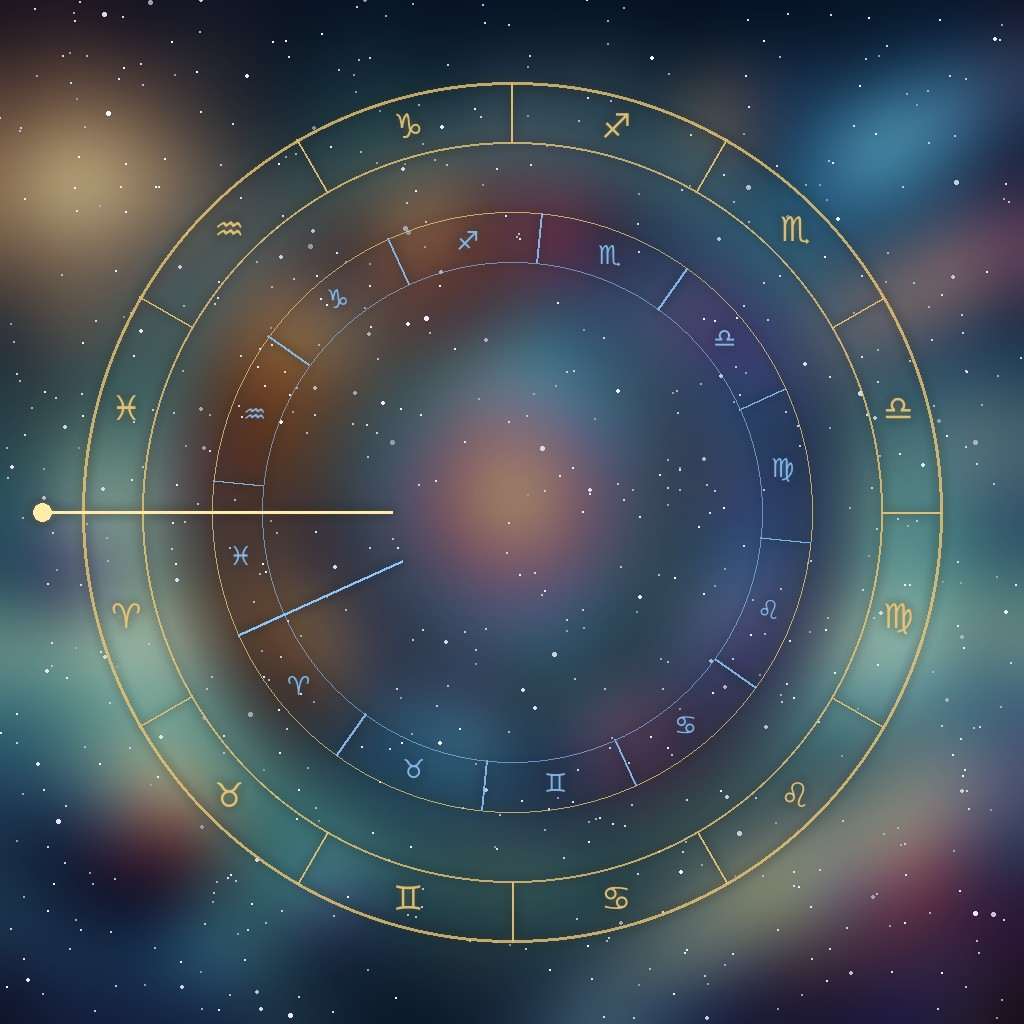
The tropical zodiac is the zodiac of Western astrology. It starts each year at the March equinox, the moment the Sun crosses the equator heading north, and that point is 0° Aries. In tropical astrology, the natal chart comes first: transits, progressions, solar returns and synastry are all read against it.
This guide explains how it works, why it follows the seasons and not the stars, and which charts matter most when you use it. We also give the exact dates the Sun enters each sign in 2026. Then we measure one thing most guides only hint at. We checked 120,000 US birth times to see how many Sun signs would change in the sidereal zodiac. The answer was 78.5%.
What is the tropical zodiac?
Picture the sky as a big clock face. The Sun seems to walk around this clock once a year. Its path is called the ecliptic, the line the Sun and planets follow across our sky. A zodiac is a way to cut that path into twelve equal slices of 30 degrees. Each slice is a sign.
The question is where to start the first slice. The tropical zodiac starts it at the March equinox. On that day, day and night are close to equal length all over the Earth. The Sun crosses the celestial equator, the sky’s version of the Earth’s equator, heading north. Astrologers call this spot the vernal point, or 0° Aries.
From there, the rest falls into place. Taurus begins 30 degrees later. Cancer begins at the June solstice, the longest day in the north. Libra begins at the September equinox. Capricorn begins at the December solstice, the shortest day in the north. So the four seasons line up with four signs: Aries, Cancer, Libra and Capricorn.
The word itself points to the seasons. In Greek, “tropos” means a turn. The solstices are the turning points where the Sun stops climbing or falling in the sky. The tropics of Cancer and Capricorn on a world map get their names from the same idea.
The short version is simple. Your Sun sign tells you where the Sun stood in the cycle of the seasons on the day you were born. It does not tell you which group of stars sat behind the Sun.
Tropical zodiac dates: when the Sun enters each sign in 2026
Because the signs are tied to the seasons, the dates barely move from year to year. They shift by a day at most, mostly because of leap years. Here are the exact 2026 dates, computed with the Swiss Ephemeris. We give each one in UTC and in New York time, since a late-evening change in the US is already the next day in UTC.
| Sign | Sun enters (UTC) | Sun enters (New York time) |
|---|---|---|
| Capricorn (2025) | December 21, 2025, 15:03 UTC | December 21, 2025, 10:03 am. |
| Aquarius | January 20, 01:45 UTC | January 19, 8:45 pm. |
| Pisces | February 18, 15:52 UTC | February 18, 10:52 am. |
| Aries | March 20, 14:46 UTC | March 20, 10:46 am. |
| Taurus | April 20, 01:39 UTC | April 19, 9:39 pm. |
| Gemini | May 21, 00:37 UTC | May 20, 8:37 pm. |
| Cancer | June 21, 08:25 UTC | June 21, 4:25 am. |
| Leo | July 22, 19:13 UTC | July 22, 3:13 pm. |
| Virgo | August 23, 02:19 UTC | August 22, 10:19 pm. |
| Libra | September 23, 00:05 UTC | September 22, 8:05 pm. |
| Scorpio | October 23, 09:38 UTC | October 23, 5:38 am. |
| Sagittarius | November 22, 07:23 UTC | November 22, 2:23 am. |
| Capricorn | December 21, 20:50 UTC | December 21, 3:50 pm. |
If you were born on one of these days, the hour decides your sign. Someone born in New York on the evening of August 22, 2026 after 10:19 pm is a Virgo. Born earlier that day, they are a Leo. That is why a birthday on the edge of a sign needs a real birth time, not a guess.
Why the tropical zodiac follows the seasons, not the stars
About 2,000 years ago, the signs and the star groups with the same names sat roughly on top of each other. They do not anymore. The reason is a slow wobble of the Earth called precession.
Think of a spinning top. As it spins, its axis traces a slow circle. The Earth does the same thing, but one full circle takes close to 26,000 years. As the axis turns, the March equinox point slides backward against the stars. The Greek astronomer Hipparchus noticed this slide in the second century BC. He compared his own star charts with older records and found they had shifted.
So there was a choice to make. Should the signs follow the seasons, or the stars? The Greek tradition chose the seasons. In the second century AD, Ptolemy wrote the Tetrabiblos, the book that shaped Western astrology for over a thousand years. In its first book, he argued that the signs should be counted from the equinoxes and solstices. His reason was that their meanings come from the seasons they bring. Spring warmth, summer heat and winter cold belong to the signs that start each season.
That choice has a cost. The signs no longer line up with the star groups that gave them their names. Here is how far apart the two have drifted, using the Lahiri ayanamsa. An ayanamsa is the number of degrees between the tropical and the sidereal zodiac. Lahiri is the official value used in India.
- On October 1, 2026, the gap was 24.23 degrees.
- The gap grows by about 1 degree every 72 years. Our measured rate was 1.40 degrees per century.
- Under the Lahiri value, the two zodiacs lined up in the year 285 AD.
- The gap will reach a full sign, 30 degrees, around the year 2439.
Not all sidereal readers use the same value. On the same date, the Fagan-Bradley value gave 25.11 degrees and the Raman value gave 22.78 degrees. The choice can move a planet near the edge of a sign.
The most important charts in tropical astrology
People ask which charts matter most in this system. The tradition gives a clear order. One chart is the base, and the rest are read against it. Here they are, from the base to the more advanced.
1. The natal chart: the base of it all
The natal chart, or birth chart, is a map of the sky at the minute and place you were born. It shows the Sun, the Moon and the planets in the twelve signs. It also shows the twelve houses. Think of the chart as a house with twelve rooms. Each room covers one area of life, like money, home or partners. The planets are the furniture. Our guide to the 12 astrological houses walks through each room.
The natal chart is the key chart in tropical astrology for a simple reason. It never changes. All the other tools compare a moving sky with this fixed map. Without it, a transit or a solar return has nothing to land on. To build it, you need three things: your birth date, your birth time to the minute, and your birth place.
2. Transits: the sky today against your birth sky
A transit is where a planet is now, compared with your natal chart. When Saturn today sits on the spot where your Sun was at birth, astrologers say Saturn is transiting your Sun. Transits are the most used timing tool in this system. They use real sky spots you can look up for any date. Our guide to planetary transits shows how to read them.
3. Secondary progressions: a slow inner clock
Progressions are a symbolic way to move the natal chart forward. In secondary progressions, each day after your birth stands for one year of your life. The sky on your tenth day of life describes your tenth year. The progressed Moon moves about one sign every two and a half years, so it marks clear chapters. Read more in secondary progressions explained.
4. The solar return: a chart for each birthday year
A solar return is a chart cast for the exact moment the Sun comes back to its birth spot each year. That moment falls on or near your birthday. Astrologers read it as a theme chart for the year ahead, always next to the natal chart. Our solar return guide explains how to find yours.
5. Synastry: two natal charts side by side
Synastry places two natal charts next to each other to see how two people connect. If your Venus sits on your partner’s Moon, the tradition reads that as a strong point of contact. Synastry is still natal work. It compares two fixed maps, not a moving sky. Our guide to synastry charts covers the main contacts.
How the five fit as one
Here is a short summary of the main charts and tools.
| Chart or tool | What it compares | Main question it answers |
|---|---|---|
| Natal chart | The sky at birth | Who am I, and what are my main themes? |
| Transits | Today’s sky against the natal chart | What is being stirred up right now? |
| Secondary progressions | One day after birth for each year of life | What chapter of growth am I in? |
| Solar return | The Sun’s return to its birth spot each year | What is the theme of this year? |
| Synastry | Two natal charts side by side | How do two people meet and mix? |
Each row after the first leans on the natal chart. That is the real answer to why the natal chart matters so much in tropical astrology. It is the one map that all the rest read from.
Tropical vs sidereal: how many signs would change?
The sidereal zodiac ties the signs to the star groups instead of the seasons. It is the zodiac of Vedic astrology, the traditional astrology of India. Our full comparison of tropical vs sidereal zodiac systems covers the debate. Here we only measure one practical point.
We took 120,000 random birth times between 1950 and 2010 in 16 large US cities. For each one, we found the Sun sign in both zodiacs. In 78.5% of births, the Sun sign changed. Most people with a tropical Aries Sun, for example, have a sidereal Pisces Sun.
The figure is not a surprise once you see the math. Across those years, the gap between the zodiacs was about 23.6 degrees on average. A sign is 30 degrees wide. So any Sun in the first 23.6 degrees of a tropical sign slides back into the sign before. That is 23.6 out of 30, or close to 79%. The Moon and the Ascendant changed sign at almost the same rate: 78.5% and 78.7%. The Sun, the Moon and the Ascendant all changed at once in 48.6% of the charts.
For a baby born in late 2026, the odds are higher, at about 81%, because the gap has kept growing. If you want to see your own chart the other way, our page on the sidereal zodiac explains how it is built.
A changed sign does not make one zodiac right and the other wrong. They measure two things. The tropical zodiac tracks the Sun against the seasons. The sidereal zodiac tracks it against the stars.
Common mix-ups about the tropical zodiac
“The tropical zodiac is broken because of precession”
This claim mixes up the two systems. The tropical zodiac never claimed to follow the stars. It follows the equinoxes, and it still does so exactly. Precession moves the stars behind the signs, not the signs themselves.
“The signs are the constellations”
The signs share names with star groups, but they are not the same thing. Each tropical sign is exactly 30 degrees wide. The star groups have uneven sizes, and some are much wider than others. A sign is a slice of the year, not a picture in the sky.
“There is a 13th sign”
The Sun does pass through the stars of Ophiuchus each year. But the tropical zodiac counts twelve equal seasonal slices, not star groups. Adding a star group would not change a system that is not based on star groups in the first place.
“The seasons flip in the Southern Hemisphere”
This one is true. In Sydney, the Sun enters Aries at the start of autumn, not spring. A few astrologers have proposed flipping the zodiac south of the equator. Most keep the standard zodiac everywhere, starting from the March equinox.
How to read your chart in the tropical zodiac: four steps
- Get your exact birth time. A full US birth certificate lists it. The Moon moves about one degree every two hours, and the Ascendant moves much faster.
- Cast the chart in the tropical zodiac. Most Western sites use it by default. If a site says “sidereal” or “Lahiri,” it is using the other system.
- Start with the big three: the Sun, the Moon and the Ascendant, the sign rising in the east at your birth. Then find the house each planet sits in.
- Add timing last. Look at today’s transits against your natal chart, then your solar return for the year.
If you would rather have the full reading done for you, our complete natal chart report reads the whole map in the tropical zodiac.
How we got these numbers
Here is the method, so you can check our figures.
- We drew 120,000 random moments between 1950 and 2010. Each moment had the same chance of being picked. We did not weight them by real birth hours.
- Each moment was paired at random with one of 16 large US cities. The city only matters for the Ascendant.
- We used the Swiss Ephemeris, a standard table of where the planets are, used by most chart software.
- Sidereal signs used the Lahiri ayanamsa, with the Swiss Ephemeris sidereal mode.
- For the 2026 dates, we found the exact minute the Sun reached each 30-degree mark. We checked each date with a second program, Astronomy Engine. The two agreed within about one minute.
- As a cross-check on the 78.5% figure, we compared it with the simple ratio of the average gap to the width of a sign. Both gave about 79%.
This zodiac is a frame for reading the sky, not a claim of science. Astrology is a symbolic language, and this guide describes how the tradition uses it.
FAQ: the tropical zodiac and tropical astrology
What is the tropical zodiac?
The tropical zodiac is the zodiac used in Western astrology. It divides the Sun’s yearly path into twelve equal signs of 30 degrees. It starts at the March equinox, which is 0° Aries, so each sign is tied to a point in the seasons.
Why is the natal chart so important in tropical astrology?
The natal chart is the fixed map of the sky at your birth. All other tools in this system are read against it. Transits, progressions, solar returns and synastry all compare something new with that one map.
What are the main charts and techniques in tropical astrology?
The main charts are the natal chart, transits, secondary progressions, the solar return and synastry. The natal chart is the base. Transits show today’s sky against it, progressions show slow inner growth, the solar return covers one year, and synastry compares two people.
How far apart are the tropical and sidereal zodiacs in 2026?
On October 1, 2026, the gap was 24.23 degrees using the Lahiri value. It grows by about 1 degree every 72 years. Other sidereal values give a slightly larger or smaller gap, from about 22.8 to 25.1 degrees.
Does tropical astrology use the constellations?
No. It uses the seasons, not the star groups. The signs share their names with constellations, but each sign is an equal 30-degree slice that starts from the March equinox.
Go deeper with your personal Astrovision report
Reading about astrological concepts is a great start, but nothing compares to hearing how they apply directly to you. Our users love our audio-first approach, calling it “friendly, personal, and easy to understand.” While this article gives you the “what,” a personal report gives you the “so what.” Discover your unique path with an Astrovision report—your personal ‘user manual’ delivered in our celebrated podcast format.