
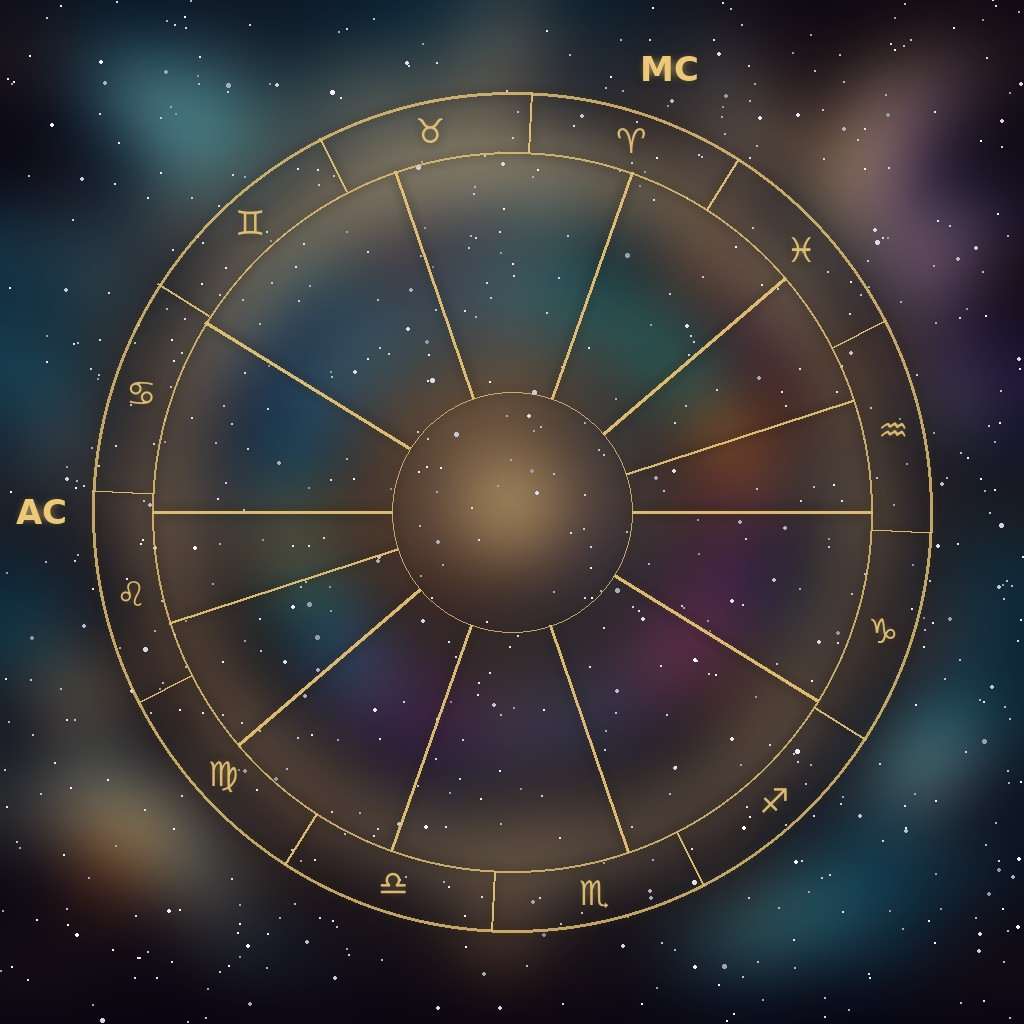
Placidus is a way to split a birth chart into its twelve houses. It cuts the sky by time, not by equal slices of space. Each house holds the stretch of sky that takes a set share of time to rise to the top of the sky, or to sink from it. That is why Placidus houses come out in uneven sizes.
It is also the house system that most astrology apps and sites use by default. So if you have ever looked up your chart online, you have most likely read it in Placidus. This guide explains what that means, where the name comes from, and what changes when you switch to another system. We tested it on 120,000 US birth charts, and the answer surprised us: Placidus and whole sign houses put about half of all planets in different rooms.
Placidus meaning in astrology, in one picture
Think of your birth chart as a house with twelve rooms. Each room covers one part of life: money, home, love, work, friends. The planets are the furniture. A house system is the floor plan. It decides where one room ends and the next one starts.
The wall between two rooms is called a cusp. The first cusp is your Ascendant, the point of the zodiac that was rising in the east when you were born. The tenth cusp is the Midheaven, the highest point the zodiac reaches above your birth place. In most house systems, these two points are fixed walls. The real question is where the other walls go.
Placidus answers with a clock. Picture a point of the zodiac as it climbs from the eastern horizon to the top of the sky. That climb takes a certain number of hours. Placidus cuts the climb into three equal parts of time. The marks between the parts become the walls of houses 12 and 11. The same rule, run on the other quarters of the sky, gives the rest of the walls.
Because each point of the zodiac climbs at its own pace, equal parts of time do not make equal rooms. Some rooms come out wide. Others come out narrow.
Placidus house system definition: how it divides the sky
Here is the short definition. The Placidus house system divides each quarter of the sky into three equal parts of time. The time it uses is the time each point of the zodiac takes to travel from the horizon to the top or bottom of the sky.
Astrologers call the path a point takes across the sky by day its diurnal arc. Half of that path, from rising to the top, is the semi-arc. So you will also see Placidus called a semi-arc system. Both names say the same thing: the walls of the rooms come from timing that climb.
The four quarters of the chart are fixed by four points. They are the Ascendant in the east, the Midheaven at the top, the Descendant in the west and the IC at the bottom. Systems that work this way are called quadrant systems, since they start from these four quarters. Placidus, Koch, Porphyry and Campanus are all quadrant systems. They differ only in how they cut each quarter into three.
You do not need to do the math by hand. The steps loop back on themselves, since the time a point needs depends on where that point sits, and the point is what you are trying to find. Before computers, this is why astrologers bought printed tables of houses.
Where the name comes from
The system takes its name from Placidus de Titis, an Italian monk of the Olivetan order who lived from 1603 to 1668. He taught math and astronomy at the University of Pavia from 1657. He set out the method in his main book, Physiomathematica, in 1650.
Placidus did not claim to have made it up. He said the method went back to Ptolemy, the Greek writer of the second century whose book the Tetrabiblos shaped Western astrology. The idea is older than Placidus in any case. The Jewish astrologer Abraham Ibn Ezra described it in the twelfth century.
The system won its place much later, and in England. English versions of his work came out in 1789 and 1814. Then, in the 1820s, the writer who called himself Raphael put Placidus tables of houses in a cheap and popular almanac. The historian James Holden pointed out why that mattered. Placidus cusps are hard to work out, but they are easy to print as a table. Once the tables were in every home, the system became the norm. The astrologer Chris Brennan traces this whole story on The Astrology Podcast.
Placidus vs whole sign: what changes in your chart
The main rival to Placidus is the whole sign system. In whole sign houses, each room is exactly one sign. The sign on your Ascendant is the whole first house, the next sign is the second house, and so on round the wheel. It is the oldest way to draw houses, used by the Greek-speaking astrologers who founded Western astrology. Our guide to whole sign houses covers that system in full.
So how much do the two systems disagree? We built 120,000 US birth charts and placed the ten planets, from the Sun to Pluto, in both. Here is what we found.
- 53.1% of all planets sit in a different house under Placidus than under whole sign.
- 96.2% of charts have at least one planet that moves.
- Only 3.8% of charts keep all ten planets in the same rooms.
- 11.4% of charts see all ten planets change house.
The shift has a clear pattern. When a planet moves, it moves one room forward in whole sign in 88.5% of cases. A planet in your Placidus 9th house lands in the 10th house in whole sign. A shift of one room back is rare, at 5.8%. A jump of two rooms forward makes up the last 5.7%.
Why forward? In whole sign, a room starts at 0 degrees of its sign. In Placidus, a room starts at the cusp, which can sit anywhere in a sign. Say your Ascendant is at 20 degrees Leo. In Placidus, a planet at 25 degrees Leo is in the first house. A planet at 10 degrees Leo is still in the twelfth house, since it sits before the cusp. In whole sign, both are in the first house, because all of Leo is the first room.
The shift hits each planet about the same, since the cause is the floor plan, not the planet.
| Planet | Share that changes house. |
|---|---|
| Sun | 53.1% of charts. |
| Moon | 53.3% of charts. |
| Mercury | 53.0% of charts. |
| Venus | 53.0% of charts. |
| Mars | 53.2% of charts. |
| Jupiter | 54.7% of charts. |
| Saturn | 53.2% of charts. |
| Uranus | 52.9% of charts. |
| Neptune | 51.8% of charts. |
| Pluto | 52.7% of charts. |
Take one placement as a test. Among charts with Venus in the first house under Placidus, 49.3% have Venus in the second house under whole sign. Only 48.4% keep it in the first. So before you read a house meaning, check which system your chart uses.
Which one is right? Astrology has no test that settles it. Both have long roots. Whole sign is the older, Greek one. Placidus has been the English and American default for about two centuries. Many astrologers read both and see which one fits the life in front of them.
A worked example: one New York chart
Here is a real chart we computed. It is not the chart of anyone in particular. The time is 15 March 1985, 2:30 pm in New York, which was 19:30 UTC. The Ascendant falls at 14°12′ Leo and the Midheaven at 4°05′ Taurus.
| House | Placidus cusp | Size of the room. |
|---|---|---|
| 1st house | 14°12′ Leo | 21.3 degrees. |
| 2nd house | 5°32′ Virgo | 26.2 degrees. |
| 3rd house | 1°47′ Libra | 32.3 degrees. |
| 4th house | 4°05′ Scorpio | 36.1 degrees. |
| 5th house | 10°14′ Sagittarius | 34.4 degrees. |
| 6th house | 14°36′ Capricorn | 29.6 degrees. |
| 7th house | 14°12′ Aquarius | 21.3 degrees. |
| 8th house | 5°32′ Pisces | 26.2 degrees. |
| 9th house | 1°47′ Aries | 32.3 degrees. |
| 10th house | 4°05′ Taurus | 36.1 degrees. |
| 11th house | 10°14′ Gemini | 34.4 degrees. |
| 12th house | 14°36′ Cancer | 29.6 degrees. |
Look at the sizes. The first house spans just over 21 degrees. The fourth spans 36. Each room is the same size as the one across the wheel, so the twelve rooms form six matching pairs.
Now place the planets. Seven of the ten stay put in both systems. Three move. Mars sits at 0°26′ Taurus, just before the 10th cusp at 4°05′ Taurus. Placidus puts it in the 9th house. Whole sign puts it in the 10th, since all of Taurus is the 10th room. Jupiter at 7°59′ Aquarius moves from the 6th to the 7th. Neptune at 3°30′ Capricorn moves from the 5th to the 6th. Each one sits early in its sign, before the Placidus wall.
Big rooms, small rooms and intercepted signs
How uneven can Placidus houses get? Across our US sample, the smallest room was 17.2 degrees wide and the largest was 54.9 degrees. Both came from Seattle, the most northern city in our list. A whole sign room is always 30 degrees, so a Placidus room can be less than two thirds of that, or nearly twice as big.
Latitude drives the gap. The farther you are from the equator, the more the zodiac tilts as it rises, and the more uneven the rooms become.
| City | Smallest room | Largest room. |
|---|---|---|
| Miami, 25.8° N | 23.2 degrees | 39.8 degrees. |
| New York, 40.7° N | 19.5 degrees | 48.1 degrees. |
| Seattle, 47.6° N | 17.2 degrees | 54.9 degrees. |
| Anchorage, 61.2° N | 9.9 degrees | 91.4 degrees. |
| Fairbanks, 64.8° N | 5.8 degrees | 124.5 degrees. |
When a room is wider than a sign, it can hold a whole sign inside it, with no wall in that sign at all. Astrologers call that an intercepted sign. Since rooms come in matching pairs, the sign across the wheel is caught too. That means intercepted signs always come in pairs.
In our sample, 51.9% of Placidus charts had at least one pair of intercepted signs. The share climbs as you go north.
| Birth city | Charts with intercepted signs. |
|---|---|
| Miami | 32.8% of charts. |
| Houston | 39.0% of charts. |
| New York | 58.2% of charts. |
| Minneapolis | 68.3% of charts. |
| Seattle | 73.2% of charts. |
So a baby born in Seattle is more than twice as likely as one born in Miami to have intercepted signs in a Placidus chart. In a whole sign chart, no sign is ever intercepted, because each room is one sign.
Modern astrologers read an intercepted sign as a theme that is hard to reach at first, a part of life that takes effort to bring out. That reading belongs to the Placidus era. The Greek astrologers who used whole sign houses never had the problem.
Why Placidus breaks near the Arctic Circle
Placidus has a hard limit. It stops working at about 66.6 degrees of latitude, the line of the Arctic Circle, and the same line south of the equator.
The reason is simple. Placidus needs every point of the zodiac to rise and set, so it can time the climb. North of the Arctic Circle, some points of the zodiac never set, and others never rise, for part of the year. You can see the same thing with the Sun there, which stays up all night in summer. A point that never crosses the horizon has no climb to time. With no time to split, Placidus has no answer for some of the walls.
The limit is not a round number by chance. It is 90 degrees minus the tilt of the Earth’s axis, which is about 23.4 degrees. The chart programs know this. The Swiss Ephemeris, the code behind most chart sites, warns and swaps in the Porphyry system once you go past the line. So a chart cast in Tromsø, Norway, or in the far north of Alaska is not a true Placidus chart, even when the screen says it is.
Trouble starts before the line. At Fairbanks, a room can shrink below 6 degrees or swell past 120. Many astrologers who work with clients born that far north switch to whole sign or equal houses.
Placidus among the other house systems
Placidus is one of more than a dozen ways to draw the twelve rooms. Here is where it stands next to the main ones. Our hub page on house systems in astrology compares them side by side.
- Whole sign: one sign per room, no cusps inside signs, no intercepted signs.
- Equal houses: twelve rooms of exactly 30 degrees each, counted from the Ascendant degree. See our guide to equal houses.
- Koch: another time-based system. The Koch house system times the Midheaven degree as seen from the birth place, rather than each cusp on its own path.
- Porphyry and Campanus: these cut the quarters by space, not by time. Porphyry and Campanus divide the sky by geometry, and Campanus still works past the Arctic Circle.
All quadrant systems share the Ascendant and the Midheaven. The planets that shift between them are the ones close to the middle walls. Whatever system you pick, the meaning of each room stays the same. Our guide to the 12 astrological houses explains what each room covers.
How to see your own chart in Placidus
You need three things: your birth date, your birth time to the minute and your birth place. The time matters most. The walls of the rooms turn with the sky, about one degree every four minutes. An hour off can shift every cusp by around 15 degrees.
- Open any chart site and enter your date, time and place.
- Check the house setting. Most sites start in Placidus. Some say so in small print under the wheel.
- Note which planets sit within a few degrees of a cusp, or early in a sign.
- Switch the setting to whole sign and look again. The planets that move are the ones to read with care.
If a planet moves rooms, read both meanings. Many astrologers hold that a planet close to the next cusp already acts in the next room. That fits the forward shift we saw in the data.
How we counted
We drew 120,000 birth moments at random from 1950 to 2010, spread evenly in time. Each one got a birth place drawn from 16 large US cities, from Miami to Seattle. We cast each chart with the Swiss Ephemeris in the tropical zodiac, the one most Western sites use. We found the Placidus cusps with the Swiss Ephemeris house routine and set each planet in its room by its zodiac degree. Then we placed the same planets in whole sign houses and compared.
We checked the work two ways. First, we ran a second, even grid of nearly 100,000 moments, one every 5 hours and 17 minutes. It gave the same answers within a few tenths of a point: 53.0% of planets moved and 96.2% of charts had a move. Second, we wrote our own Placidus routine from the textbook rule and compared it with the Swiss Ephemeris on 20,000 charts. The two never differed by more than a millionth of a degree. That same routine fails, as it should, from 66.56 degrees of latitude.
Our sample counts every hour of the day the same, while real births are not spread that way. The shares are a fair guide to the floor plan, not a census of real people.
Frequently asked questions
What is Placidus in astrology?
Placidus is a house system, a rule for cutting a birth chart into twelve houses. It splits each quarter of the sky into three equal parts of time, so its houses come out in uneven sizes. It is the default on most astrology apps and sites.
What does Placidus mean in a birth chart?
If your chart says Placidus, the walls between your houses were drawn with this time-based rule. Your signs and planets do not change. Only the house each planet falls in can change. In our test of 120,000 US charts, 53.1% of planets sat in a different house under whole sign.
Is Placidus or whole sign more accurate?
Nothing proves one over the other. Whole sign is the older system of the Greek astrologers. Placidus has been the English and American norm since the 1800s. Many astrologers compare both on a known life and keep the one that reads true.
Why does my Placidus chart have intercepted signs?
A Placidus room can be wider than a sign. When a whole sign fits inside one room, no wall falls in it, and that sign is intercepted. It happens in pairs, across the wheel, and more the farther north you are born. It hit 32.8% of Miami charts and 73.2% of Seattle charts in our sample.
Does Placidus work everywhere?
No. It fails past about 66.6 degrees north or south, near the polar circles. There, some points of the zodiac never rise or never set, so there is no time to split. Chart programs then switch to another system, such as Porphyry.
Go deeper with your personal Astrovision report
Reading about astrological concepts is a great start, but nothing compares to hearing how they apply directly to you. Our users love our audio-first approach, calling it “friendly, personal, and easy to understand.” While this article gives you the “what,” a personal report gives you the “so what.” Discover your unique path with an Astrovision report—your personal ‘user manual’ delivered in our celebrated podcast format.