
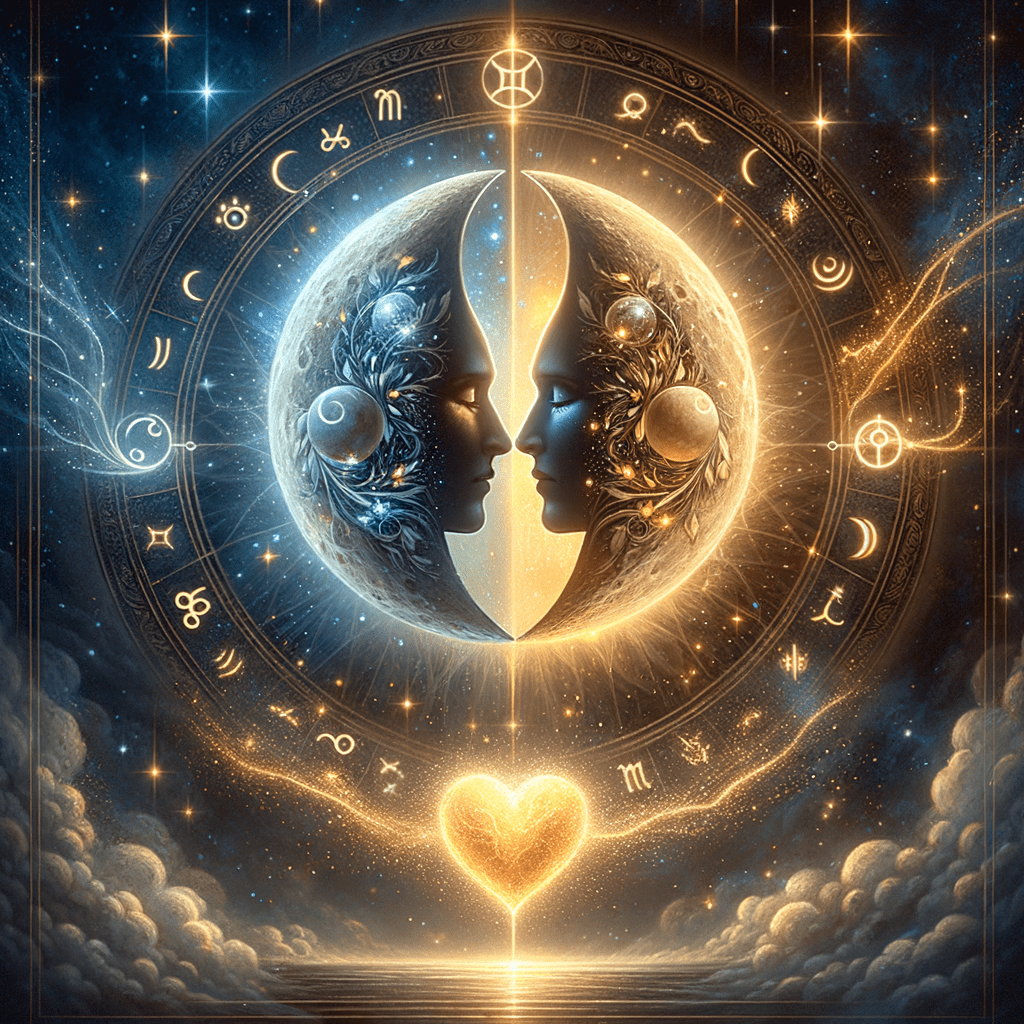
Most guides tell you that a Moon in Gemini makes you curious. That is true, and it is not the useful part. The useful part is this: with the Moon in Gemini, a feeling does not arrive as a mood. It arrives as a sentence. You know you are upset because you hear yourself explaining why.
This changes what comfort looks like for you. A hug helps a Cancer Moon. A Gemini Moon needs someone to pick up the phone.
What the Moon actually rules in a birth chart
Your birth chart is a map of the sky at the hour you were born. Think of it as a house with twelve rooms. Each room covers one part of life. The planets are the furniture inside.
The Moon is not one piece of furniture among many. It is the thermostat. It sets your default state when nothing is pushing on you.
The Sun shows what you aim at. The Moon shows what you reach for when you are tired, scared, or safe at last. Robert Hand, whose 1981 book Horoscope Symbols is still a standard text, framed the Moon as the part of us that reacts before we choose to react.
Your Moon sign is simply the sign the Moon stood in on your birthday. The Moon crosses all twelve signs in about a month, so the Sun sign you read in a magazine tells you nothing about it. To place any planet in the sky you need a clear picture of what the Moon governs before the sign layer goes on top.
Why Gemini changes the way the Moon works
Gemini has three labels that matter here. Each one is easy to explain.
- It is an air sign. Air signs deal in thought, speech, and contact between people. Water signs deal in feeling, earth signs in matter, fire signs in drive.
- It is mutable. Astrologers sort signs into three modes. Cardinal signs start things. Fixed signs hold them. Mutable signs bend and switch. Gemini bends.
- Mercury rules it. Every sign has a ruling planet, an owner whose nature colors the room. Mercury is the planet of speech, writing, trade, and short trips.
Put those together. The Moon wants safety. Gemini finds safety in words. So the fastest way to soothe a Gemini Moon is to name the problem out loud. Silence is not restful here. Silence is the threat.
Because Mercury owns the sign, your Moon takes orders from it. Where Mercury sits in your chart shapes how your feelings sound when they finally come out. Mercury in its own sign of Gemini makes that voice quicker still.
How common is a Gemini Moon? We ran the numbers
People ask if this placement is rare. No one answers with a figure. So we counted.
Here is the method, so you can check it. We stepped through the sky at a fixed pace, one reading every six hours, from 1 January 1600 to 1 January 2400. At each step we computed the true position of the Moon, then read off the sign. Eight centuries smooth out the Moon’s slow cycles, which a span of sixty years does not. We ran it twice, on the Swiss Ephemeris and on the astronomy-engine library, and the two agree to the second decimal.
The result: the Moon is in Gemini 8.33 % of the time. A perfectly even split would give 8.33 %. Every one of the twelve signs lands between 8.33 % and 8.34 %.
So the honest answer is that a Gemini Moon is neither rare nor common. It is one in twelve, near enough. About one person in every school class of thirty has one. Anyone selling you a rare-placement story is selling you nothing.
Fifty-four hours: the shortest weather in the sky
The second number is more interesting, and it explains the reputation.
We tracked the Moon minute by minute from 2015 to 2035 and timed every crossing. The Moon spends 54.3 hours in Gemini on average. Across 2020 to 2030 the shortest crossing ran 47.1 hours and the longest ran 61.1 hours. That is a swing of fourteen hours between one visit and the next.
Why the swing? The Moon rides an oval path, not a circle. When it is near Earth it moves fast. When it is far it slows down. So no two Gemini Moons last the same length of time.
Hold that image. Your Moon sign is the sign with the least staying power of any sign the Moon crosses. Gemini’s average of 54.3 hours is the fourth shortest of the twelve, below Libra’s 55.3. The sky itself does not linger here. Neither do you.
What the old books said, and what modern astrologers changed
Sources matter, and they disagree in useful ways.
Claudius Ptolemy, writing in Alexandria around 150 AD, built the frame we still use in the Tetrabiblos. He read the Moon as the body of moisture and growth, and he read Gemini as a sign of speech and duality. A Moon in Gemini sat oddly for him: the wet planet in a dry, airy room.
Vettius Valens, a Greek astrologer of the same century whose Anthologies survive in full, was blunter. He tied Gemini to trade, teaching, and going back on your word.
Fifteen centuries later the English astrologer William Lilly wrote Christian Astrology, printed in 1647. Lilly gave the Gemini Moon a sharp wit and a loose grip on promises. Old texts judge. That was the style.
The twentieth century turned the judgment into a question. Liz Greene, the Jungian analyst and astrologer, reads a placement like this as a defence: the mind speeds up to keep the heart at a safe distance. Demetra George, who brought the Greek sources back into English practice, points out that the same restlessness reads as skill in one chart and as flight in another. Chris Brennan, whose 2017 book Hellenistic Astrology traces where these ideas came from, makes the wider point: the old writers described outcomes, not personality types.
The gap between Lilly and Greene is not a fight about facts. It is a change in what astrology is for. Lilly wanted to predict. Greene wants to understand.
The Moon in Gemini woman, without the old script
Search for this and you get the same paragraph everywhere. She is chatty. She is flighty. She gets bored.
Strip the script and something sharper shows up. A woman with this Moon processes out loud. That is the whole mechanism. She works out what she feels by saying it, which means her first sentence is a draft, not a verdict.
This causes one specific problem in her close relationships. Partners treat the draft as final. She says she is done with the job, the city, the whole thing. Two hours later she is fine, because saying it was the work. The other person is still holding the sentence.
What helps: say which sentences are drafts. “I am thinking out loud” costs four seconds and saves an evening.
The Moon in Gemini man: restless, not cold
The charge against this placement is coldness. It lands wrong.
A man with the Moon in Gemini feels the thing and then reaches for a joke, a fact, or a change of subject. To him that is the feeling, handled. To the person across the table it looks like the feeling was refused.
What he wants from a partner is not less talk. It is a partner who stays interested. Boredom reads to him the way a cold room reads to a Taurus Moon: as a sign that he is not safe here.
Our page on Taurus Moon and Gemini Moon compatibility looks at that exact gap between two partners.
A Virgo Moon partner answers to Mercury as well, which our page on Gemini Moon and Virgo Moon compatibility explores.
The growth edge is plain. Sit with one subject past the point where it stops being fun. That is the muscle this Moon does not build on its own.
“Are Gemini Moons crazy?” A fair answer
Ninety people a month type that into Google. The question deserves better than a shrug.
What people are describing is speed. A Gemini Moon can hold two opposite feelings at once and voice both inside a minute. Watched from outside, that looks like a switch flipping. From inside there is no switch. Both feelings were there the whole time.
The twin symbol is doing real work. Gemini is the sign of two figures, not one. Valens read the doubling as a warning. Greene reads it as an honest picture of how minds work.
The real cost is not madness. It is worry. A mind this quick will run a small worry in circles at three in the morning, and the running feels like solving. It is not solving. Naming it to another person is what stops it, which is why this Moon needs a friend more than it needs a plan.
Who fits a Gemini Moon
Moon-sign match asks a narrow question: do two people find comfort in the same way? Astrologers call the wider study of chart-to-chart contact synastry.
An Aries Moon partner adds action to the talk, in the sextile that our page on Aries Moon and Gemini Moon compatibility examines.
- Air Moons. Libra and Aquarius share the talking cure. Easy, and thin on depth if nothing else in the two charts adds weight.
- Fire Moons. Aries, Leo, and Sagittarius match the pace. A Sagittarius Moon sits directly opposite Gemini, and opposite signs pull hard: same axis, other end.
- Water Moons. Cancer, Scorpio, and Pisces want feeling held in silence. This is the hard, useful pairing. Each partner learns the skill they lack.
- Earth Moons. Taurus, Virgo, and Capricorn want a settled routine. Virgo shares Mercury as ruler, which gives the two of you a shared language even when the pace clashes.
One warning. Sun-sign lists rank matches from best to worst. Real charts do not work that way. Two Gemini Moons can bore each other flat, and a Gemini Moon with a Scorpio Moon can last forty years.
In the old system of Ptolemy, those two signs share no bond at all, as our page on Gemini Moon and Scorpio Moon compatibility explains.
Our page on Gemini Moon and Gemini Moon compatibility counts how many same-sign couples are close in degrees, not just in name.
Next door, our page on Gemini Moon and Cancer Moon compatibility sets a Gemini Moon beside the Moon in its own home sign.
One sign further on, a Leo Moon sits in the home of the Sun, as our page on Gemini Moon and Leo Moon compatibility shows.
Across the wheel, a Sagittarius Moon moves at the same restless pace, as our page on Gemini Moon and Sagittarius Moon compatibility shows.
A Libra Moon shares the air element and forms a trine, as our page on Gemini Moon and Libra Moon compatibility sets out.
A Pisces Moon meets Gemini at a square, and our page on Gemini Moon and Pisces Moon compatibility reads it as two signs that each end a season.
With a Capricorn Moon, an old rule of Ptolemy, read by exact degree, has Gemini command and Capricorn obey, as our page on Gemini Moon and Capricorn Moon compatibility explains.
An Aquarius Moon shares the air element, and our page on Gemini Moon and Aquarius Moon compatibility shows how Mercury and Saturn split the rule of air.
Every Gemini Moon of 2026, to the hour
Transits are a different subject from your birth chart. A transit is where a planet is right now, moving over the fixed map you were born with. The Moon crosses Gemini every month, and those two days have a texture.
We computed each crossing for 2026. Times are UTC. Subtract five hours for New York in winter, four in summer.
- 27 January, 20:55 – 29 January, 22:32
- 24 February, 02:29 – 26 February, 05:12
- 23 March, 08:19 – 25 March, 10:33
- 19 April, 16:18 – 21 April, 17:01
- 17 May, 02:23 – 19 May, 01:47
- 13 June, 13:06 – 15 June, 12:15
- 10 July, 22:42 – 12 July, 22:47
- 7 August, 06:08 – 9 August, 07:46
- 3 September, 11:48 – 5 September, 14:31
- 30 September, 17:26 – 2 October, 19:55
- 28 October, 01:02 – 30 October, 02:06
- 24 November, 11:10 – 26 November, 10:52
- 21 December, 22:27 – 23 December, 21:59
What to do with the list. These windows suit talking, drafting, short trips, and errands that need a phone call. They suit deep focus badly. If you were born with this Moon, these are the days you feel most like yourself.
Living with this Moon
Four practices, each aimed at a real weakness of the placement.
Write the loop down. A worry that circles in your head has no end. On paper it ends after four lines. The page does what a friend does, at two in the morning when no friend is awake.
Label your drafts. Warn people when you are thinking out loud. This one sentence prevents most of the fights this placement creates.
Pick one boring hour a day. One task, one subject, no phone. You are not training focus for its own sake. You are proving to yourself that a dull hour is survivable.
Feed the input. Books, podcasts, strangers, arguments. Starve a Gemini Moon of new material and it will manufacture drama to have something to chew on.
Frequently asked questions
What does the Moon in Gemini mean?
It means your emotional default runs through language. You settle a feeling by putting it into words, out loud or on a page. Comfort comes from contact and news, not from stillness.
Is a Gemini Moon rare?
No. Measured over 800 years of sky, from 1600 to 2400, the Moon sits in Gemini 8.33 % of the time. That is the even split across twelve signs.
How long does the Moon stay in Gemini?
54.3 hours on average, measured across every crossing from 2015 to 2035. The shortest between 2020 and 2030 lasted 47.1 hours, the longest 61.1 hours.
Are Gemini Moons flirty?
They are interested, which reads as flirty. Attention is how this Moon makes contact, and it does not switch off in a queue or a lift. The pattern is curiosity, not pursuit.
Who is a good match for a Gemini Moon?
Air and fire Moons match the pace with the least friction. Water and earth Moons make the harder, more useful pairing, because each side has to learn the other’s way of settling down.
How do I find my Moon sign?
You need your date, place, and time of birth. The Moon changes sign about every two and a half days, so an hour of error can move it. A birth certificate beats a family memory here.
Is a Gemini Moon better or worse than another Moon sign?
Neither. William Lilly ranked placements in 1647 because his clients wanted verdicts. Modern practice, from Liz Greene onward, reads the same placement as a set of strengths and costs that depend on the rest of the chart.
Go deeper with your personal Astrovision report
Reading about astrological concepts is a great start, but nothing compares to hearing how they apply directly to you. Our users love our audio-first approach, calling it “friendly, personal, and easy to understand.” While this article gives you the “what,” a personal report gives you the “so what.” Discover your unique path with an Astrovision report—your personal ‘user manual’ delivered in our celebrated podcast format.