
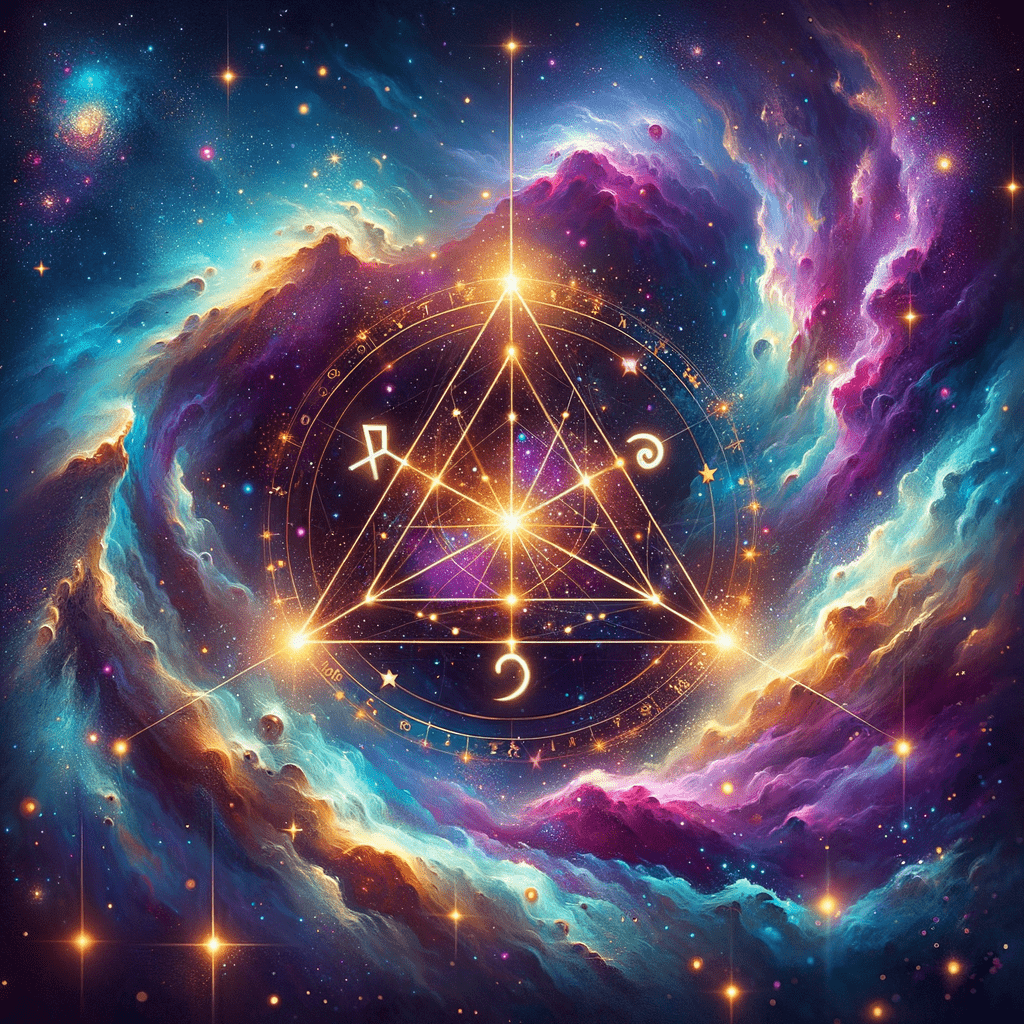
A grand trine is three planets that sit about 120° from each other. Drawn on the chart wheel, they make a closed triangle with three equal sides. Books call it rare, lucky, and a sign of a gift. Nobody says how rare.
So we counted. Across one million birth moments from 1940 to 2030, about 1 chart in 12 holds a grand trine. That figure uses the Moon, the Sun and the eight planets, with a 6° margin. Change the margin or the list of points and the answer moves from 1 in 71 to 1 in 4. This page gives every number, the method behind it, and what the old texts say about the figure.
The shape in one picture
Every planet sits somewhere on the ring of the zodiac, which is the band of twelve signs that circles the chart. Two planets that stand 120° apart form a trine, one of the five major angles. Now add a third planet 120° from both of them. You get three trines at once. That closed loop is the grand trine.
No planet sits on a perfect 120°. So astrologers allow a margin on each side of the exact angle. That margin is the orb. With a 6° orb, any gap from 114° to 126° counts as a trine. For a grand trine, all three gaps must pass the test at the same time.
The three corners land in three signs four apart. Signs four apart share an element. The zodiac has four of them, fire, earth, air and water, with three signs each. So a grand trine is almost always a triangle inside one element. We will see below that “almost” hides a real number.
How rare is a grand trine? We counted
Here is the method, so anyone can repeat it.
We took birth moments spread evenly from 1 January 1940 to 1 January 2030, one every 2 hours 23 minutes. That gave 329,060 charts. For each one we worked out the tropical position of the Sun, the Moon, and the planets from Mercury to Pluto. Tropical means the zodiac is fixed to the seasons, as in all Western charts. For the rising sign and the top of the chart, we placed every birth in New York.
Then we tested every set of three points. A set counts when each of its three gaps sits within the orb of 120°. We ran the test at orbs of 3°, 6° and 8°, and with three lists of points.
A second, separate run checked the first. It drew one million random birth times with a fixed seed, and it took the planet places from the JPL DE440 tables. JPL is the NASA lab that tracks the planets for space flights. The two runs agree to within 0.07 points on every line of the table below.
| Points counted | Orb of 3° | Orb of 6° | Orb of 8°. |
| Sun and the eight planets | 1.40 % (1 in 71) | 4.99 % (1 in 20) | 8.75 % (1 in 11). |
| Same, plus the Moon | 2.42 % (1 in 41) | 8.35 % (1 in 12) | 13.99 % (1 in 7). |
| Same, plus rising sign and midheaven | 4.89 % (1 in 20) | 16.97 % (1 in 6) | 27.39 % (1 in 4). |
The middle line is the one most chart apps use. It gives 1 chart in 12.
The same method also checks out against our own page on the major aspects. That page reports 2.46 trines per chart for births from 1950 to 2010, with ten bodies and a 6° orb. Our code, run on the same window, gives 2.46 as well.
So a single trine is common. Nine charts in ten hold one. Three trines that close into a loop are not. That gap is the whole story of the grand trine.
Your orb decides whether you have one
Look along any line of the table. Going from 3° to 8° multiplies the count by close to six. Not one planet moved.
The reason is simple. A single trine needs one gap to pass. A grand trine needs three gaps to pass at once. Each extra degree of orb helps all three legs, so the effect stacks up. Errors stack up the same way.
The list of points matters just as much. Add the Moon and the count rises by two thirds. The Moon crosses the whole zodiac each month, so it falls into a waiting triangle more than any planet does. Add the rising sign and the midheaven, the point at the top of the chart, and the count doubles again. Those two points move fast with the clock. A birth time ten minutes out shifts them by two or three degrees.
So when a chart report tells you that you have a grand trine, ask two things. Which orb? Which points? A triangle that needs the rising sign and an 8° orb is a weak claim. One made of three planets inside 3° is a strong one.
Generational grand trines: three short windows since 1940
Jupiter, Saturn, Uranus, Neptune and Pluto move slowly. When three of them form a grand trine, everyone born in those weeks shares it. Astrologers call this kind of figure generational, because it belongs to a birth group, not to a person.
We expected many of them. We found three, and all three were brief. Here is the full list from 1940 to 2030, at a 6° orb. Dates are in UTC, to the day.
| Planets | Element | From | To | Length. |
| Jupiter, Saturn, Neptune | Water | 17 Jan 1967 | 6 Mar 1967 | 49 days. |
| Jupiter, Saturn, Uranus | Air | 5 Feb 1974 | 20 Mar 1974 | 44 days. |
| Jupiter, Saturn, Neptune | Water | 24 Jun 2013 | 12 Aug 2013 | 50 days. |
Both routes gave the same dates to the day. At a tight 3° orb the windows shrink to 2 days in February 1967, 22 days in 1974, and 25 days in July 2013. The 2013 one was close to exact on 18 July, with the three planets at 5° of Cancer, Scorpio and Pisces.
Add them up and only 0.44 % of the people born in those ninety years carry a grand trine made of slow planets alone. That is 1 person in 227. All the rest need at least one fast point: the Sun, the Moon, Mercury, Venus or Mars. In 19 charts out of 20 that hold a grand trine, no slow-planet triangle is present at all.
This matters for reading. A grand trine with a fast corner is personal. The day, and for the Moon the hour, decides it.
Your birth decade changes the odds
The rate is not steady over time. It swings by decade, because the slow planets set up the frame that the fast ones fill in. Here is the share of charts with a grand trine, using the Moon, the Sun and the planets at a 6° orb.
| Born in the | Charts with a grand trine. |
| 1940s | 8.75 %, or 1 in 11. |
| 1950s | 7.68 %, or 1 in 13. |
| 1960s | 8.45 %, or 1 in 12. |
| 1970s | 9.31 %, or 1 in 11. |
| 1980s | 3.45 %, or 1 in 29. |
| 1990s | 6.10 %, or 1 in 16. |
| 2000s | 9.66 %, or 1 in 10. |
| 2010s | 10.03 %, or 1 in 10. |
| 2020s | 11.75 %, or 1 in 9. |
The 1980s stand out. Through most of that decade, Saturn, Uranus, Neptune and Pluto sat bunched in Scorpio, Sagittarius and Capricorn. Planets packed into one part of the sky cannot serve as the far corners of a triangle. So fewer triangles could close. Both runs found the same 3.45 %.
The 2020s run the other way. Uranus and Pluto stand in trine, within 6°, off and on from mid 2024 to 2030. Uranus sits in late Taurus, then Gemini, and Pluto in Aquarius. Any Sun, Moon or planet at the matching degrees of Libra closes the loop.
We also ran the count over a far longer span, 1600 to 2400. There the rate is 12.32 %, or 1 in 8. The swings grow too, from 3.45 % in the 1980s to over 30 % in the 1770s. So the ninety years that hold almost every living reader are a lean stretch for this figure. The label “rare” is fair for people alive today. It is not a fixed law of the sky.
Which element forms the most grand trines
Each grand trine sits in one of the four elements, or, now and then, in none. Here is how the 1940 to 2030 charts split, with the Moon counted and a 6° orb. A chart can hold more than one grand trine, so the lines add up to a bit more than 8.35 %.
| Element of the triangle | Charts that hold one. |
| Air: Gemini, Libra, Aquarius | 2.26 %, or 1 in 44. |
| Water: Cancer, Scorpio, Pisces | 2.06 %, or 1 in 49. |
| Earth: Taurus, Virgo, Capricorn | 1.65 %, or 1 in 61. |
| Fire: Aries, Leo, Sagittarius | 1.45 %, or 1 in 69. |
| Mixed: corners in two elements | 1.27 %, or 1 in 79. |
Air leads, and fire comes last. The long run from 1600 to 2400 gives the same top and the same bottom, with air at 3.32 % and fire at 2.27 %. Earth and water swap places there.
Why would the elements differ at all? The slow planets again. Neptune spent 1942 to 1957 in Libra, and Pluto spent 1971 to 1984 there too. Both are air. Neptune in Scorpio and Pisces, and Pluto in Scorpio, gave water a long run. Fire had fewer slow guests in this window. The fast planets then fill in whatever frame the slow ones build.
So a fire grand trine is the least common of the four for anyone born since 1940. That does not make it better or worse. It only makes it less shared.
When the triangle breaks the element rule
Look at the last line of that table. Some grand trines are not in one element at all.
Here is how it happens. Put the Sun at 28° of Taurus, the Moon at 26° of Virgo, and Jupiter at 1° of Aquarius. Every gap sits within 6° of 120°, so the loop closes by degree. But Aquarius is an air sign. The triangle is two parts earth and one part air.
At a 6° orb, 13.3 % of all grand trines we found were mixed like this. At 3° the share falls to 5.7 %. At 8° it climbs to 17.2 %. Our trine page found the same effect for single trines. The wider the orb, the more loose trines slip across a sign line.
Some astrologers call a mixed triangle “out of sign”. Hellenistic astrologers, who read aspects by whole signs, would not count it at all. Chris Brennan, in Hellenistic Astrology, sets out that older rule. So check the three signs before you read the figure as fire, earth, air or water.
Grand trines you could watch in the sky
Grand trines happen overhead too, and the dates are checkable. Searches for “water grand trine” jumped fivefold in November 2025, and the sky explains why.
From 14 to 20 November 2025, the Sun in Scorpio joined Jupiter in Cancer and Saturn in Pisces. All three sat near 25° of their signs. The loop was exact to 0.16° on 17 November, UTC. Mercury, Venus and Mars each took a turn at that Scorpio corner across October to December.
A second one is in the sky as this page goes live. Uranus sits in early Gemini and Pluto in early Aquarius, in trine. From 25 to 29 September 2026, UTC, the Sun in early Libra closes an air grand trine with them. It sits at 2.42° from exact on 28 September.
Babies born on those days carry the figure. So the “one chart in twelve” is not spread evenly. It clusters on certain weeks.
What the tradition says about the triangle
The named figure is modern. The idea under it is old.
Claudius Ptolemy, in the Tetrabiblos in the second century, grouped the twelve signs into four triangles. Each triangle held three signs of one element and had its own planetary rulers. He called these triplicities, from the word for a group of three. Vettius Valens, in his Anthologies, used the triplicity lords as a core tool for judging a life. Neither author named a three-planet figure as such. Their triangle was a set of signs, not a set of planets.
William Lilly, in Christian Astrology in 1647, treated the trine as the most helpful of the angles. He gave each planet its own orb, which made some trines far wider than others.
The grand trine as a named pattern comes from twentieth-century astrology. Here the readers split. Stephen Arroyo, in Astrology, Psychology and the Four Elements, read the balance of elements as a map of energy. Too much of one element was as much a problem as too little. Liz Greene has argued that ease is not a gift in itself: a talent that costs nothing is a talent rarely used. Robert Hand, in Planets in Aspect, made a similar case. The hard angles push. The soft ones supply.
Demetra George stresses the order of work. Read the structure first. Read meaning second. That order fits the numbers above. Count the figure, check its orb and signs, and only then read it.
How to read a grand trine in your own chart
Take the steps in this order.
- Write down the orb of each of the three legs. The widest leg is the weak link. A loop held at 2° is a firm figure. One held at 7° is a borderline case.
- Check the three signs. If they share one element, read the element. If they do not, read the triangle as mixed.
- Sort the corners. Three slow planets mean a birth group shares it. A Sun, Moon or personal planet at a corner makes it yours.
- Note which houses hold the corners. The houses show the parts of life that the loop ties together.
- Look for a hard angle that plugs into the loop. A planet opposite one corner turns the figure into a kite. A T-square elsewhere adds the push that a trine lacks.
- Only then read meaning. Match the element to the style. Match the mode, cardinal, fixed, mutable, to how each corner acts.
A closed loop can feel like a room with no door. Energy runs around the triangle and back. The tradition reads this as ease, not as success. What turns ease into skill is use, and that part stays with the person.
Frequently asked questions
How rare is a grand trine?
About 1 birth chart in 12 holds one, for people born from 1940 to 2030. That counts the Sun, Moon and eight planets with a 6° orb. A 3° orb gives 1 in 41. Adding the rising sign and midheaven gives 1 in 6.
What is the most common grand trine element?
Air, in 2.26 % of charts from 1940 to 2030. Water comes next at 2.06 %, then earth at 1.65 % and fire at 1.45 %. Air also leads over the long span from 1600 to 2400.
Is a grand trine a generational aspect?
Rarely. Only 0.44 % of people born from 1940 to 2030 have one built from slow planets alone. There were three short windows: early 1967, early 1974 and mid 2013. In 19 charts out of 20 that hold one, the triangle needs the Sun, Moon or a fast planet.
Can a grand trine be in two elements?
Yes. When a corner sits near the edge of a sign, the loop can close by degree across two elements. That was true of 13.3 % of the grand trines we found at a 6° orb.
Is a grand trine lucky?
The tradition reads it as ease between three planets. It does not promise any outcome. Modern writers such as Liz Greene and Robert Hand warn that ease without challenge goes unused.
What orb should I use for a grand trine?
Use a tight one, 3° to 5° per leg. The figure needs three trines at once, so a wide orb inflates the count fast. Going from 3° to 8° makes grand trines close to six times more common.
What was the water grand trine in November 2025?
The Sun in Scorpio formed a grand trine with Jupiter in Cancer and Saturn in Pisces from 14 to 20 November 2025, UTC. It was exact to 0.16° on 17 November. Mercury, Venus and Mars each took that Scorpio corner in turn.
Go deeper with your personal Astrovision report
Reading about astrological concepts is a great start, but nothing compares to hearing how they apply directly to you. An Astrovision natal chart analysis finds every grand trine in your chart, gives the orb of each leg, and names the element and the houses it ties together. You get it in writing and in our celebrated podcast format.